CPR (Hands-Only) + AED
CPR + AED Course Singapore (Hands-Only) | SRFAC
Last updated: 20 August 2026
3 hours · SRFAC syllabus
Certificate valid two years
TL;DR: The CPR AED course Singapore training centres run today is CPR(Hands-Only)+AED, an SRFAC-accredited basic course in compression-only adult CPR and defibrillation. You pass a theory paper of at least 10 questions at 80 per cent, plus a practical test of 120 seconds of continuous compressions. The Provider certificate runs two years.
CPR + AED Course
Click a card to flip and view key details
Hands-only CPR removes the part most bystanders hesitate over. No mouth-to-mouth, no pulse check, no ratio to count. You press, hard and without stopping, until an AED or a paramedic arrives.
That simplicity is deliberate. This page sets out what the CPR AED course Singapore learners book actually covers, how the practical test is scored, what the AED rules ask of you, and how long the certificate lasts. Every figure below comes from SRFAC, SCDF or Singapore Statutes Online.
1
What is the CPR+AED course in Singapore?
Quick Answer: The CPR AED course Singapore recognises is officially titled CardioPulmonary Resuscitation (Hands-Only) with Automated External Defibrillator, abbreviated CPR(Hands-Only)+AED. SRFAC lists it as one of four accredited Basic courses, alongside BCLS+AED, Standard First Aid and Child First Aid.
The full title matters because certificates are checked against it. SRFAC publishes the official course titles for every accredited course, and requires certificates to carry the exact title plus the words “Accredited by the Singapore Resuscitation and First Aid Council”.
One date reshaped this course. SRFAC withdrew CPR(Mouth-To-Mouth)+AED from 1 May 2020, and hands-only became the default from the same date.
- Hands-only is now the standard. Accredited CPR+AED Training Centres are permitted to conduct CPR(Hands-Only)+AED courses only.
- Ventilations moved to BCLS+AED. SRFAC encourages learners who need mouth-to-mouth skills to enrol in BCLS+AED instead.
- The skill set is adult-focused. Compression-only adult CPR and AED use. Infant resuscitation and choking relief sit in other courses.
So if a booking form still says “CPR+AED”, it is asking for this course. The Standard First Aid course is the wider qualification that contains it.
Key takeaway: There is only one CPR+AED course accredited in Singapore today, and it is the hands-only version.
Not sure which first aid course your role needs?
The pillar guide sets out how the SRFAC course family fits together. Compare the SRFAC first aid courses →
2
Who the hands-only course suits, and who needs more
Quick Answer: CPR(Hands-Only)+AED suits anyone who wants a recognised resuscitation certificate without a wider first aid or clinical scope. It does not satisfy a workplace first aider appointment, and it is not the certificate SRFAC requires for entry into advanced life support courses.
Three groups arrive at this course, and only one is in the right place.
- General staff, volunteers and residents. People who want to act competently on a collapsed adult, with no clinical role attached. The course is designed for them.
- Appointed workplace first aiders. The Workplace Safety and Health (First-Aid) Regulations require first aiders where more than 25 persons are employed, in a ratio of one first aider for every 100 persons employed. That appointment calls for a first aid course, not a resuscitation-only one.
- Clinical staff and advanced-course candidates. SRFAC has required a valid BCLS+AED Provider certificate since 1 May 2023 for enrolment in advanced provider and instructor courses. A hands-only certificate does not open that door.
The second group needs Standard First Aid, kept current through the Standard First Aid refresher course. The third needs BCLS+AED. Booking hands-only when the requirement names either of those is the costliest mix-up in this course family. A basic first aid and AED session sits below all three, introducing the same reflexes without an accredited assessment.
Key takeaway: Read the requirement before you book. Hands-only answers “can you resuscitate”, not “are you the appointed first aider”.
3
What the SRFAC hands-only protocol actually asks you to do
Quick Answer: SRFAC’s CPR and AED Protocol runs the same opening sequence for both course tracks, then diverges at the breathing check. On the hands-only track there is no pulse check and no ventilation, so the rescuer moves straight from a 10-second breathing look to continuous chest compressions.
Hands-only CPR is often described as “BCLS minus the breaths”. The protocol shows two steps are worded differently, not merely removed.
| Protocol stage | CPR(Hands-Only)+AED | Mouth-to-mouth track |
|---|---|---|
| Danger, response, call 995 | Identical | Identical |
| Breathing check | Chest rise and fall only, up to 10 seconds | Chest rise and fall plus pulse, up to 10 seconds |
| Compression pattern | Continuous compressions | 30 compressions to 2 ventilations |
| Minimum practice time | 4 minutes continuous | 4 minutes of cycles |
| Rest permitted | Up to 10 seconds, preferably after 100 compressions | Not applicable during cycles |
| Stop condition on recovery | Normal breathing returns | Normal breathing or pulse returns |
Source: SRFAC, CPR and AED Protocol for BCLS+AED and CPR+AED, 2019.
The rest rule is the line most learners miss. SRFAC allows a pause of up to 10 seconds during the hands-only phase, but only before an AED is in play, and preferably after 100 compressions. Once the AED is attached, the device dictates the pauses, not your fatigue.
Key takeaway: Hands-only is not a shortened protocol. It is a differently worded one, and the wording changes what you are assessed on.
4
How the practical assessment is scored
Quick Answer: The hands-only practical runs for 120 seconds with the timing cut off at that point. You must deliver at least 180 chest compressions, and up to 30 per cent of them may carry technique errors. Wrong hand position outside the lower sternum is an immediate fail.
Those numbers set a floor of roughly 90 compressions a minute, which is why instructors push for a faster rhythm in practice.
| Criterion | Hands-only | Mouth-to-mouth |
|---|---|---|
| Assessment window | 120 seconds | 130 seconds |
| Minimum compressions | 180 | 150 |
| Error allowance | Up to 30% of compressions | Up to 30 errors |
| Ventilations required | Not assessed | At least 5 above 400 ml |
| Attempts allowed | Up to 3 | Up to 3 |
Source: SRFAC, 2023 Accreditation Guide for BCLS+AED and CPR+AED TC/ITC; SRFAC CPR and AED Protocol.
Three faults count against the error allowance: insufficient recoil, incorrect depth, and hand position that is improper but still within the lower sternum. Each must be visually verified by the instructor. Hand position visibly outside the sternum is not counted as an error at all. It ends the attempt.
Two delivery rules shape how much practice you get before that test. SRFAC sets a default instructor-to-manikin-to-learner ratio of 1:1:4, relaxing to 1:2:6 for manikin work where equipment and instructor experience allow. E-learning packages may deliver the theory lesson online, but both assessments stay in the instructor’s presence.
Key takeaway: More compressions in less time than the mouth-to-mouth track. The hands-only test is shorter, not easier.
5
Using an AED: when compressions stop and when they carry on
Quick Answer: Under SRFAC’s protocol, compressions continue while the chest is exposed and the pads are applied. They pause only while the AED analyses or charges, and while a shock is delivered. A “no shock advised” result is not a stop signal.
Most AED errors in a real arrest are timing errors, not device errors. Each stage below maps to what your hands should be doing.
| AED stage | Compressions | What the rescuer does |
|---|---|---|
| Scene check | Continue | Clear wet or metallic surfaces and any flammable gas nearby |
| Exposing the chest | Continue | Wipe dry, shave hair if it blocks the pads, move a necklace aside |
| Applying the pads | Continue | Keep pads four fingers clear of a pacemaker; remove medicated patches |
| Analysing and charging | Pause | Nobody in physical contact with the casualty |
| Shock advised | Pause, then resume | Deliver the shock when safe, then go straight back to compressions |
| No shock advised | Continue | Follow the prompts and keep compressing |
| Casualty recovers | Stop | Leave the AED connected until the paramedic is ready |
Source: SRFAC, CPR and AED Protocol for BCLS+AED and CPR+AED, 2019.
SRFAC also requires learners to practise several shock sequences rather than one, so “no shock advised” never reads as failure. The practical checklist must include one of those sequences, excluding the all-no-shock combination.
Only the machine stops your hands. Nothing else in the sequence does.
Key takeaway: Compressions pause for analysis, charging and the shock itself. Every other AED step happens while you are still pressing.
Training a floor team or a whole office?
Group runs can be scheduled at your premises where space and manikin ratios allow. Ask about corporate CPR+AED scheduling →
6
Theory paper, certificates and the renewal window
Quick Answer: The theory paper carries at least 10 questions with an 80 per cent pass mark and up to three attempts. Pass both assessments and a Provider certificate is issued within 30 days. It is renewable from three months before the stated expiry to three months after.
The paperwork side has more rules than most learners expect, and each one has a practical consequence.
| Requirement | Specification |
|---|---|
| Theory assessment | |
| Question paper sets available | At least 3, used interchangeably |
| Minimum questions per paper | 10 |
| Pass mark | 80% |
| Attempts allowed | Up to 3 |
| Certificate | |
| Issued within | 30 days of course completion |
| Must state | Course type, learner’s full name, validity, serial or course reference number, SRFAC accreditation wording |
| If only theory is passed | Certificate of Attendance, not a Provider certificate |
| Renewal window | 3 months before to 3 months after expiry |
| New validity runs from | The stated expiry date, or the date of training |
Source: SRFAC, 2023 Accreditation Guide for BCLS+AED and CPR+AED TC/ITC.
Two rows deserve a second look. A Certificate of Attendance rests on acceptance by your employing institution and does not stand in for a Provider certificate. And because renewed validity can run from the stated expiry date, renewing early costs you nothing.
Key takeaway: Diarise the expiry date the week the certificate arrives. Renewing early is free; renewing late means starting over.
7
Where hands-only CPR sits inside Standard First Aid
Quick Answer: CPR(Hands-Only)+AED is an integral part of Standard First Aid. SRFAC retitled “SFA+AED” as simply SFA for that reason, and the CPR component inside Standard First Aid has been the hands-only version since 1 June 2019.
That overlap answers a question people ask constantly: whether a Standard First Aid holder also needs a separate CPR+AED certificate. They do not.
- SFA contains the hands-only component. That is why the “+AED” was dropped from the course title.
- The training centres overlap too. A Standard First Aid training centre must itself be an accredited CPR+AED or BCLS+AED Provider training centre.
- Scope is the difference. Standard First Aid adds bleeding, burns, fractures, conscious choking and medical emergencies.
The real question is how wide a certificate your requirement names. Where a workplace, a coaching registry or a school asks for first aid, the Standard First Aid course is the one to book, and the SFA refresher keeps it current.
Key takeaway: Standard First Aid already contains hands-only CPR and AED. Take the standalone course when resuscitation is all the requirement names.
8
Why Singapore built its response around bystanders
Quick Answer: SCDF reports that more than 2,300 people in Singapore suffer cardiac arrest each year, and that only 3 per cent survive. It also reports that survival chances fall by 7 to 10 per cent every minute, and that bystander CPR doubles survival rates.
Those three figures explain why the course is short, compression-focused and aimed at the public rather than clinicians. Under the Save-A-Life initiative, SCDF pairs training with a dispatch system that finds trained people already nearby. Its myResponder app alerts Community First Responders to a potential cardiac arrest within 400 metres, and is linked to the national AED registry so the nearest device can be found on the way.
That 400-metre radius is the design brief for this course. It assumes the useful responder is a neighbour or a passer-by rather than a professional, and that the skill has to survive months of disuse. Compression-only technique holds up under that assumption. Ambulance response sits on the other side of the same equation, and Medlink runs HCSA-licensed ambulance services alongside its training work.
Key takeaway: The course is built for the person already standing there. That is where the minutes are won or lost.
9
Course fees, GST and SkillsFuture funding
Quick Answer: Fees for the CPR AED course Singapore providers run are quoted in SGD, inclusive of GST. Where a course is listed on the MySkillsFuture portal, SkillsFuture Credit may be applied. Eligibility is set by SWDA, not by the training centre.
Four checks make a fee comparison more useful than it looks at first glance:
- Is the quote GST-inclusive? Medlink quotes CPR+AED fees inclusive of GST, so the figure you see is the figure you pay.
- What does it include? A complete quote covers the learner guide, both assessments and the certificate.
- Is funding a separate question? Yes. SkillsFuture Credit applies to approved courses on the MySkillsFuture portal, and eligibility is decided by the Skills and Workforce Development Agency (SWDA, formerly SWDA).
- Is there a group rate? Corporate runs are quoted per session rather than per head, so the arithmetic changes above a certain headcount.
For current fees, dates and group pricing, speak to the Medlink training team.
Key takeaway: Compare GST-inclusive fees against what each fee includes, and treat SkillsFuture eligibility as a separate question.
10
Inside Medlink’s CPR + AED course
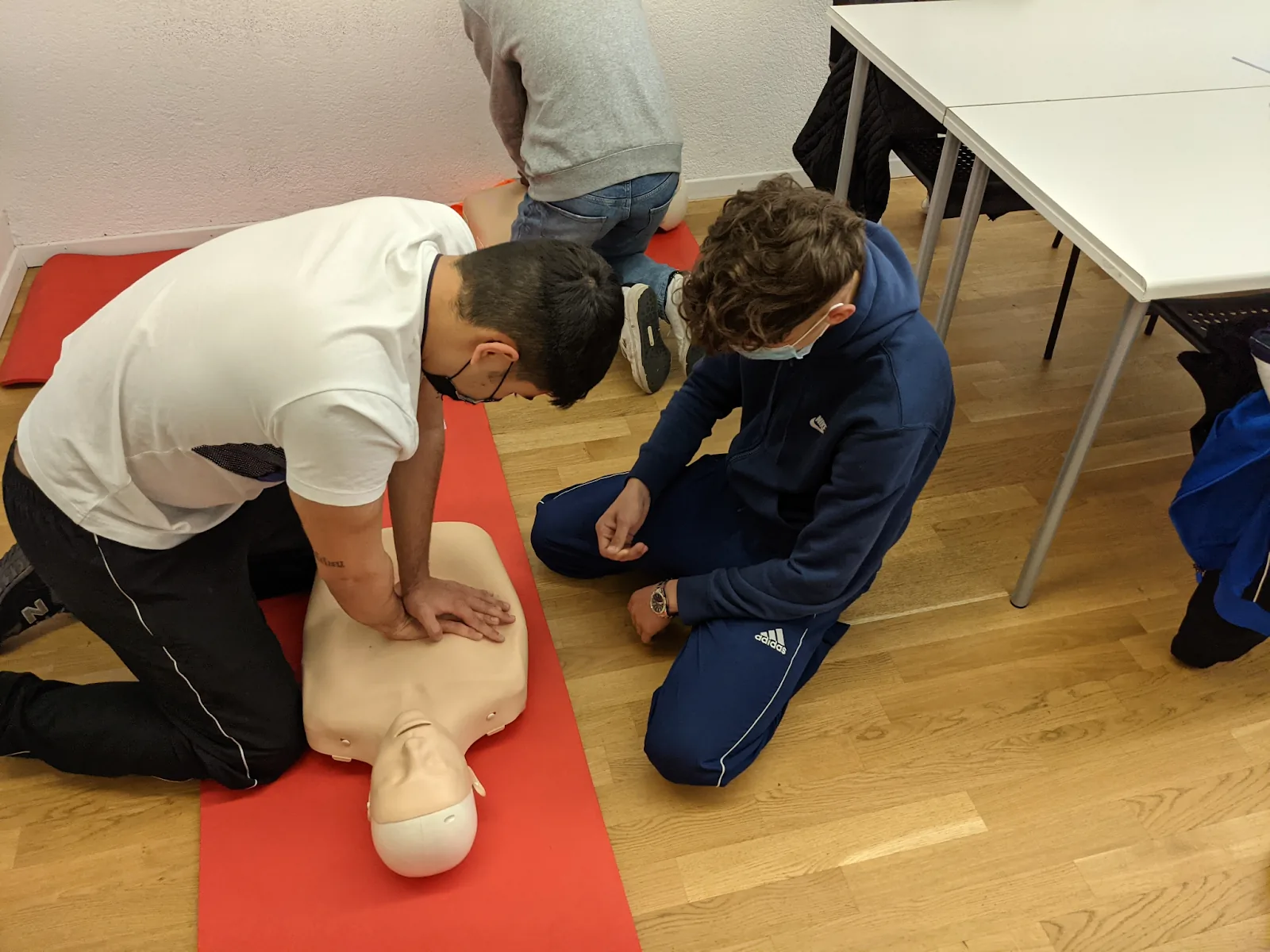
Quick Answer: Medlink runs CPR + AED as a single three-hour session at 30 Sam Leong Road, covering the chain of survival, the warning signs of heart attack and cardiac arrest, hands-only compressions and AED use. The theory paper is ten questions at an 80% pass mark; the practical needs a 100% score.
Medlink publishes the session content as five areas:
- The chain of survival.
- Signs and symptoms of a heart attack.
- Signs and symptoms of a cardiac arrest.
- How to perform cardiopulmonary resuscitation (CPR).
- How to use an automated external defibrillator (AED).
Entry requirements and health notes. Trainees need enough English to follow the session, which runs in English and Tamil on alternating Thursdays. Physical fitness matters here too: part of the assessment calls for two minutes of continuous compressions. Anyone with back, knee, spinal, joint, heart or lung conditions should consult a doctor first, and trainees who are or may be pregnant are advised to enrol after maternity leave.
| Component | Requirement |
|---|---|
| Theory paper | 10 multiple-choice questions, 80% to pass, three attempts allowed |
| Practical | Scenario-based; a 100% score is required to pass |
| Attempts | Three, on both theory and practical |
| Attendance | 100% required to be eligible for assessment |
| Results | Released on the day of training, or within two working days |
Source: Medlink Healthcare Group, CPR + AED course page, read 23 September 2026.
Certification
What the course awards on successful completion.
1
Cardiopulmonary Resuscitation (CPR) + AED Provider Certificate
Accredited by SRFAC and valid for two years, issued in credit-card format once results are released.
The practical has no partial credit. Every step of the sequence has to be right, which is why a three-hour course still carries a formal assessment.
Key takeaway: Three hours buys you a real SRFAC provider certificate, but only if you pass a practical that allows no mistakes.
Accreditation
11
How to arrange CPR+AED training with Medlink
Quick Answer: Booking runs in four steps. Confirm which course the requirement names, check whether you are certifying fresh or renewing, pick a date with margin before your deadline, then register learners’ details as they appear on NRIC or passport.
Most booking problems trace back to the first two steps, so work through them in order:
- Confirm the course name. CPR+AED means this course. First aid means Standard First Aid. BCLS means BCLS+AED.
- Check your existing certificate date. Inside the window, including the three months after expiry? A renewal run applies. Past it? Book the full course.
- Pick a date with margin. Certificates are issued within 30 days, so leave room before someone needs to see one.
- Register full official names. SRFAC requires the learner’s full name on the certificate, and corrections after issue cost time.
Medlink is a Singapore healthcare group whose work spans first aid training, industrial paramedicine and ambulance services. On corporate bookings, the team will flag where a mixed group is better split across CPR+AED and first aid courses.
Key takeaway: Confirm the course name, check the certificate date, then book with margin. Those three checks prevent most booking problems.
12
Conclusion: a short course with a long shelf life
Quick Answer: The CPR AED course Singapore recognises gives you a two-year certificate in compression-only adult CPR and defibrillation, assessed against a fixed SRFAC standard. It is the shortest accredited route to a recognised resuscitation certificate in Singapore.
The CPR AED course Singapore employers book asks for one clear skill: press hard, press without stopping, and let the AED tell you when to lift your hands. Everything in the SRFAC standard exists to make that skill survive the months between the classroom and the moment it is needed.
If your requirement is wider than resuscitation, the Standard First Aid course fits better. If it is narrower and no certificate is needed, a basic first aid and AED session covers it. If it names CPR+AED, start here.
13
Frequently asked questions
Two years. SRFAC allows renewal from three months before the stated expiry date to three months after it, and the fresh two-year validity may run from the stated expiry date rather than the training date. Past that grace period, you retake the full course.
Eighty per cent, on a paper of at least 10 questions, with up to three attempts. Training centres hold at least three question sets and use them interchangeably. The practical assessment also allows three attempts.
CPR(Hands-Only)+AED assesses compression-only adult CPR and AED use. BCLS+AED adds rescue ventilations, infant CPR and choking relief, on a longer theory paper of at least 20 questions. Only BCLS+AED opens entry to SRFAC advanced life support courses.
No. SRFAC withdrew CPR(Mouth-To-Mouth)+AED from 1 May 2020, and hands-only became the default from that date. Learners who need ventilation skills are encouraged to enrol in BCLS+AED instead.
Only partly. SRFAC allows the theory lesson to be completed online on e-learning packages, but the hands-on practice and both assessments must take place in the instructor’s presence.
Not on its own. The Workplace Safety and Health (First-Aid) Regulations require appointed first aiders where more than 25 persons are employed, in a ratio of one for every 100 persons. That appointment is met with a first aid course rather than a resuscitation-only one.
Ready to book your CPR + AED course?
Tell us whether you are certifying for the first time, renewing before an expiry date, or training a team. We will confirm the right course, the available dates and a GST-inclusive quote.
More From Medlink
Popular first aid courses
Explore other SRFAC and SWDA-accredited courses run by our team, from infant care to workplace certification.
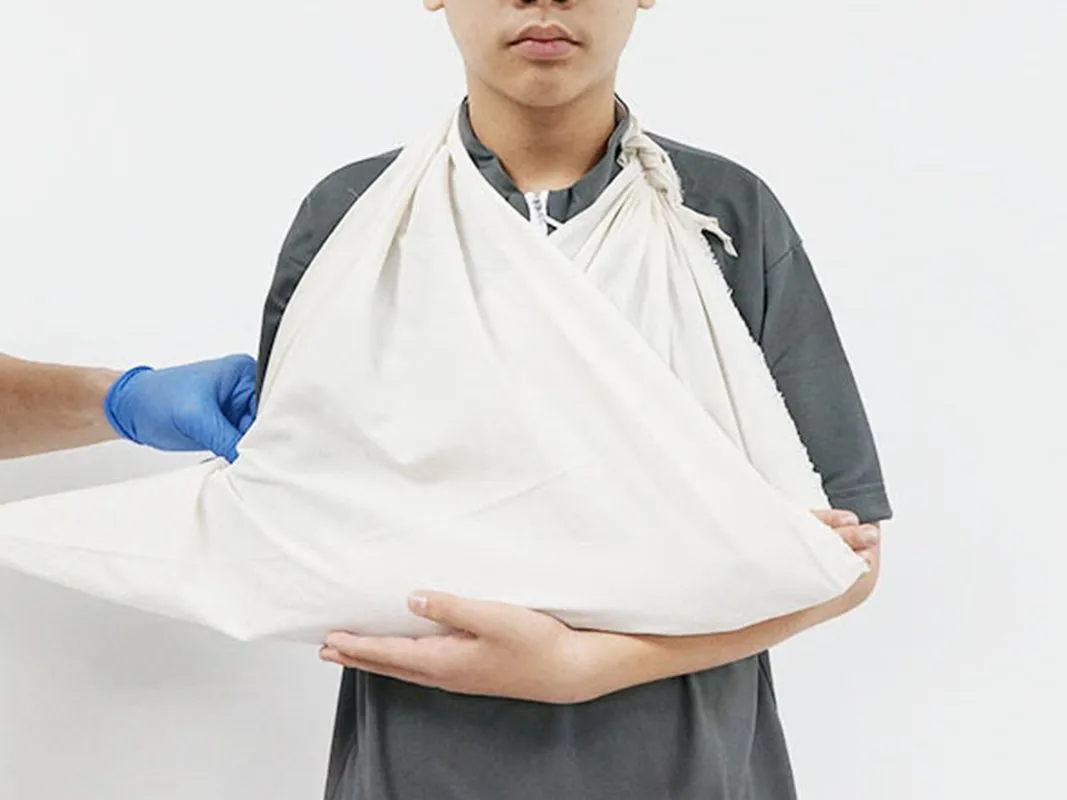
Standard First Aid
+ AED
$196.20 incl. GST ($180 before GST)
See Details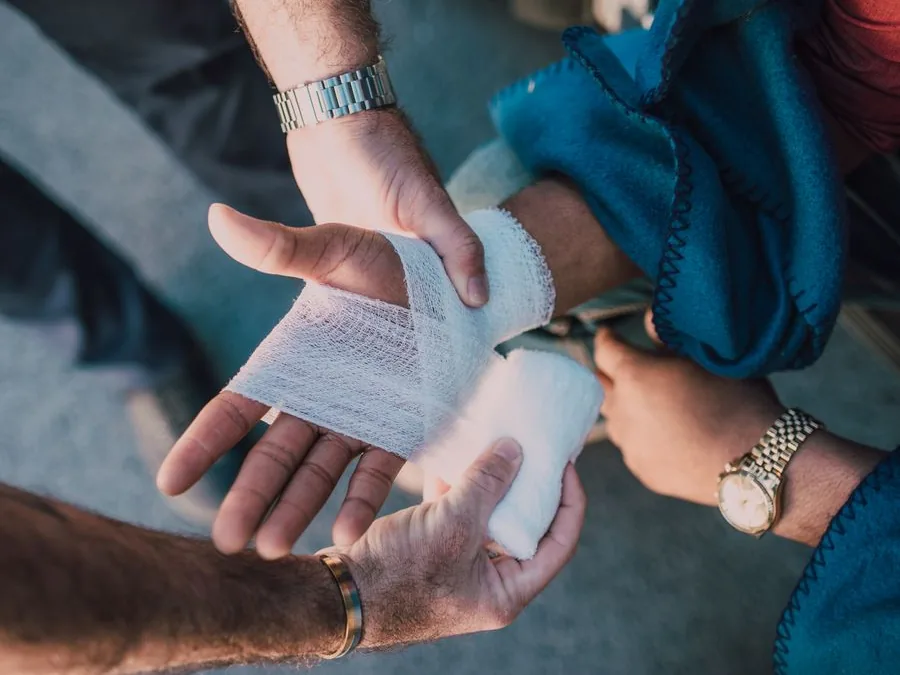
Basic First Aid
+ AED
$141.70 incl. GST ($130 before GST)
See Details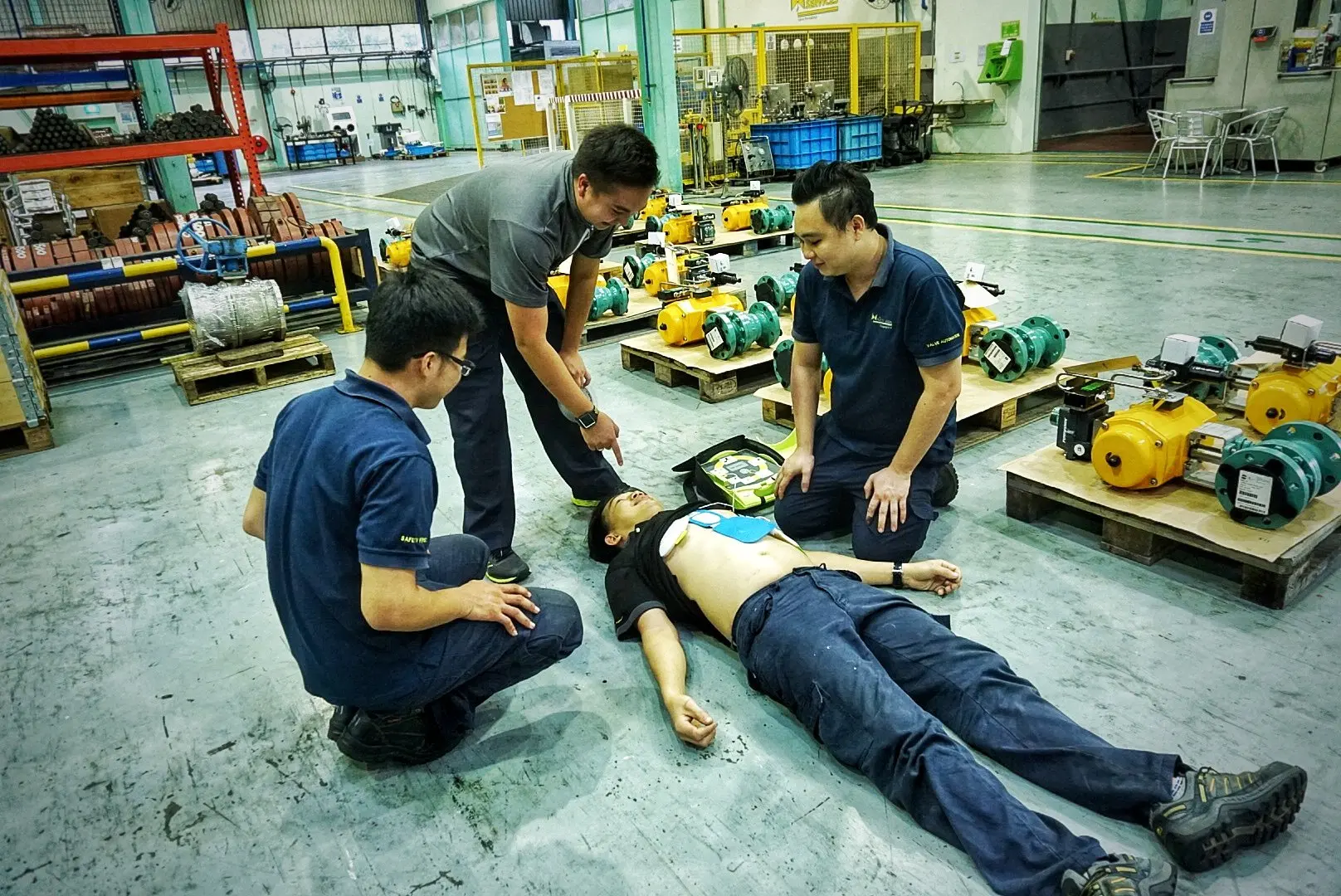
Occupational First Aid
+ AED
$346.62 incl. GST ($318 before GST)
See Details