


Occupational First Aid
Occupational First Aid Course Singapore (OFA + AED)
Last updated: 20 August 2026
24 hours · 3 days
SkillsFuture funding available
TL;DR: The Occupational First Aid Course (OFAC) is the training route for a person appointed as a workplace first aider under Singapore’s Workplace Safety and Health (First-Aid) Regulations. The WSH Council Technical Notes set the main course at 23 hours 30 minutes, including 2 hours 40 minutes of assessment, with the OFA and CPR + AED certification valid for two years.
Occupational First Aid Course
Click a card to flip and view key details
| Trainee’s Profile | Course Fee (inclusive GST) | SWDA Grant Amount | Balance Payable by SkillsFuture Credit/Cash (inclusive of GST) |
|---|---|---|---|
| Singapore Citizen / PR aged 21 years and above | $346.62 | $159.00 | $187.62 |
| Singapore Citizen aged 40 years and above | $346.62 | $222.60 | $124.02 |
| Trainee’s Profile | Course Fee (inclusive GST) | SWDA Grant Amount | Balance Payable by Cash (inclusive of GST) |
|---|---|---|---|
| Singapore Citizen / PR aged 39 years and below | $346.62 | $159.00 | $187.62 |
| Singapore Citizen aged 40 years and above | $346.62 | $222.60 | $124.02 |
| Singapore Citizens / PRs | $346.62 | $222.60 | $124.02 |
Course fee inclusive of GST. Grant amounts are estimates based on the prevailing SWDA calculator and are subject to change. Source: Medlink Healthcare Group course fee schedule, 28 September 2026.
1
Introduction: the first aider your worksite is required to name
Quick Answer: An occupational first aid course Singapore employers book is not general interest training. It qualifies a named individual to be appointed as a workplace first aider, a role the WSH (First-Aid) Regulations attach to headcount, to shift patterns and to a written notice on the wall.
Most first aid pages talk about skills. This one starts with an appointment. Under Singapore law the duty does not sit with the learner. It sits with the occupier of the workplace, who must keep enough trained first aiders available during working hours and post their names where staff can read them.
It is written for the WSH officer deciding how many people to send, and for the worker just told they are one of them. Every figure below traces to MOM, the WSH Council, Singapore Statutes Online, SRFAC or SWDA.
Key takeaway: The training fills a named legal role, so the question is not “who wants to attend” but “how many appointments do we owe”.
Not sure whether your team needs OFA or SFA?
The two routes carry different hours, governing bodies and entry rules. Compare the Standard First Aid course options →
2
Who should attend an Occupational First Aid course in Singapore?
Quick Answer: The WSH Council names the target audience as any individual interested in first aid or assigned a WSH-related role, who is physically fit and able to help another person during an emergency. That is the pool your appointed first aiders come from.
The WSH Council’s Occupational First Aid Course notes describe OFAC as a mandatory training course for occupational first aiders, aimed at rendering first aid during an emergency or accident at the workplace. Two entry conditions carry weight:
- A WSH-related role or a genuine interest. The course assumes no clinical background, so supervisors, safety coordinators and general staff all qualify.
- Physical capability. Learners must be fit enough to assist a casualty, because the assessment includes one-rescuer CPR and a one- and two-man carry.
The heaviest users are the sectors MOM identifies as carrying the highest injury load. Construction accounted for 148 fatal and major injuries in 2025 and Manufacturing for 124, per the MOM Workplace Safety and Health Report 2025. Offices, warehouses and kitchens carry the same duty at the same thresholds.
Key takeaway: There is no professional prerequisite. The gate is physical capability and a workplace that needs the appointment filled.
3
How many first aiders must a Singapore workplace appoint?
Quick Answer: Where more than 25 persons are employed, the WSH (First-Aid) Regulations require one first aider per 100 persons employed, or part thereof, readily available during working hours. The same ratio must hold on every shift.
| Duty | Triggering threshold | What is required |
|---|---|---|
| Appoint first aiders | More than 25 persons employed | One first aider per 100 persons employed, or part thereof, readily available during working hours |
| Cover every shift | Any shift work schedule | The same ratio on every shift |
| Training standard | Every appointed first aider | A training course acceptable to the Commissioner, plus re-training as required |
| Post the names | Where appointments are made | A notice stating the names of appointed first aiders |
| Keep treatment records | Every first aider | A record of all treatment rendered |
| Provide a first-aid room | More than 500 persons at work | A room of a standard approved by the Commissioner |
| Drenching and flushing | Toxic or corrosive substances present | Eye and body flushing facilities within the work area |
Source: WSH (First-Aid) Regulations, Rg 4, regulations 4 to 7.
The phrase that trips people up is “or part thereof”. A site with 260 employees needs three first aiders, not two, because the third partial hundred still counts. Run the arithmetic per shift, not per payroll.
Regulation 8 puts the penalties on the occupier: a fine of up to $20,000 or imprisonment of up to two years, rising to a fine of up to $50,000 for a repeat offender. A first aider who fails to keep a treatment record faces a fine of up to $10,000.
Key takeaway: Round the ratio up, apply it shift by shift, and remember the regulations also ask for a posted notice and a treatment log.
4
How long is the Occupational First Aid course?
Quick Answer: The Occupational First Aid course runs 23 hours 30 minutes and the Occupational First Aid refresher course runs 17 hours 30 minutes, per the WSH Council Technical Notes. Both include the same 2 hours 40 minutes of assessment, so the refresher saves training time, not assessment time.
| Component | Main course | Refresher |
|---|---|---|
| CPR and use of AED | 3 h 20 min | 2 h 50 min |
| Fractures and soft tissue injuries | 3 h | 3 h |
| Wounds, bleeding and shock | 2 h | 1 h |
| Handling and transporting the injured | 1 h | 1 h |
| Written and practical assessment | 2 h 40 min | 2 h 40 min |
| Total course duration | 23 h 30 min | 17 h 30 min |
Source: WSH Council, Technical Notes for the Occupational First Aid Course, Annex A.
Two class rules follow from the same document. Maximum class size is 18 learners. Recommended ratios are one facilitator to 18 for lectures but one to six for manikin practice, which is why practical days run in small groups even when the classroom is full.
Attendance is a gate, not a formality: 75% across the whole course, and 100% for the CPR and AED component.
Key takeaway: Budget three working days for the main course. The refresher trims training hours, never the assessment block or the CPR attendance rule.
5
What does the Occupational First Aid syllabus cover?
Quick Answer: The Occupational First Aid course syllabus runs 15 topics, from the legal duties of a first aider through to industrial toxicology and eye injuries. The WSH Council frames six essential skill sets every learner must demonstrate before being assessed competent.
The six skill sets are the practical spine of the course, and they map directly onto what a workplace casualty looks like:
- Handling and transporting an injured person. One-man and two-man techniques.
- CPR and use of an AED. The component carrying the strictest attendance rule.
- Breathing difficulties and unconsciousness. Choking, fume inhalation, asthma and drowning.
- Management of wounds and bleeding. Bandaging of head, trunk and limbs.
- Stabilising a fracture injury. Immobilisation and splinting.
- Management of burns. Electrical, dry, scald, chemical and radiation burns.
Around those sit the topics that separate OFA from general first aid — industrial toxicology, eye injuries and irrigation, accident prevention, and the legal rules on first-aid boxes, rooms and appointments. Learners also practise the survey structure MOM publishes for workplaces, DRSABC followed by SAMPLE.
Key takeaway: Six practical skill sets carry the assessment, but the chemical, eye-injury and legal modules are what make this a workplace qualification rather than a general one.
6
How is the OFA course assessed, and what is the pass mark?
Quick Answer: Learners must pass the theory, practical and oral examinations. The WSH Council sets the pass mark at 70% for the occupational first aid questions and 80% for the CPR and AED questions. Fail CPR and AED and the whole course is retaken.
| Component | Duration | Standard applied |
|---|---|---|
| Theory, closed book | 40 min | Minimum 40 MCQs — 20 OFA, 10 CPR, 10 AED. Pass at 70% for OFA, 80% for CPR and AED |
| Practical: CPR and AED | 10 min per learner | One-way resuscitation mask used; a fail here fails the whole examination |
| Practical: bandaging | 5 min per learner | Covers at least head, trunk and limbs; a fail means retaking this practical only |
| Oral: case scenarios | 5 min per learner | One to two workplace case scenarios, assessed on a checklist |
| Attendance | Whole course | 75% across the course; 100% for CPR and AED |
| Assessor independence | All components | The facilitator who taught the class may not assess it; assessor to learner ratio 1:18 for theory |
Source: WSH Council, Technical Notes, sections 2.3 and 6.6.
The asymmetry in the retake rules is worth planning around. Fail the bandaging practical and you resit that one component. Fail CPR and AED and the entire course repeats — a full 23 hours 30 minutes again, not an afternoon.
Key takeaway: CPR and AED carries the highest pass mark, the strictest attendance rule and the heaviest retake penalty. Prepare for that component first.
Planning a full-team certification round?
Class size caps at 18, so multi-site rollouts need early scheduling. Ask about Occupational First Aid course dates →
7
What injuries do workplace first aiders actually treat?
Quick Answer: MOM recorded 22,710 workplace injuries in 2025, excluding platform workers. Cuts and bruises led the minor count at 7,825, while crushing, fractures and dislocations led major injuries at 368 of 586 — which is why bandaging and splinting carry so much course time.
| Injury type | Minor injuries | Major injuries |
|---|---|---|
| Cuts and bruises | 7,825 | n/a |
| Sprains and strains | 3,555 | 0 |
| Crushing, fractures and dislocations | 3,029 | 368 |
| Burns | 830 | 45 |
| Bites and stings | 406 | n/a |
| Puncture wounds | 270 | n/a |
| Concussions | 101 | 12 |
| Amputations | n/a | 94 |
Source: MOM, WSH Report 2025, Tables 4c and 5c. “n/a” = not separately reported at that severity. Major-injury burns exceed 20 days of medical leave.
Read the table against the syllabus and the design logic is obvious. Bandaging, splinting and bleeding control cover the two largest categories on both sides of the severity line. Burns account for 830 minor and 45 major injuries, which is why chemical, electrical and scald burns are taught separately.
One more figure is worth watching. Occupational disease cases reached 1,028 in 2025. Heat disorder and diseases caused by excessive heat rose from 1 case in 2024 to 13, which is why heat illness sits inside the unconscious-patient module.
Key takeaway: The syllabus is weighted towards what workplaces actually report — soft tissue damage, fractures and burns — not towards rare catastrophic events.
8
Is Occupational First Aid an SRFAC course?
Quick Answer: No. SRFAC lists four accredited basic courses — BCLS+AED, CPR (Hands-Only)+AED, Standard First Aid and Child First Aid. Occupational First Aid sits under MOM and the WSH Council instead, though its CPR and AED portion is recognised by the National Resuscitation Council.
This point confuses buyers more than any other. Two separate governance tracks exist:
- The SRFAC track. Standard First Aid, Child First Aid, BCLS+AED and CPR (Hands-Only)+AED. Used for sports coaching licences, early childhood settings and general first aid certification.
- The MOM and WSH Council track. The Occupational First Aid Course. Providers are accredited by MOM, issue a Safety Pass in the standard MOM template, and follow the WSH Council Technical Notes.
Only OFAC is described by the WSH Council as the mandatory course for occupational first aiders. If your driver is compliance on an industrial site, OFA is the direct fit. For sports, childcare or community settings, the Standard First Aid course is the SRFAC-accredited route, with the Standard First Aid refresher handling renewals.
Key takeaway: OFA is a MOM and WSH Council qualification, not an SRFAC one. Choose by setting: industrial workplace, or general and community first aid.
9
How long is the certificate valid, and how do you renew?
Quick Answer: The WSH Council Technical Notes set the validity for CPR + AED and OFA at two years. Renewal runs through the 17-hour-30-minute refresher, and the provider must issue the Safety Pass no later than one month after assessment.
Three administrative points matter for record-keeping:
- Two years, both components. CPR + AED and OFA validity run together, so one diary entry covers both.
- One month to issue. Safety passes must reach learners within one month of assessment.
- Two years of records. Providers keep training records for no less than two years for audit.
The practical risk is a first aider whose certificate lapses while their name is still on the notice board. Track expiry dates alongside the appointment list, and book the OFA refresher course before the two-year mark.
Key takeaway: Two years, then a refresher. Keep the expiry dates on the same sheet as the posted list of appointed first aiders.
10
Renewing: the Occupational First Aid Refresher
Quick Answer: If your Occupational First Aid certificate is still valid, you renew with the 2-day Occupational First Aid Refresher rather than sitting the full course again. It is $292.12 including GST ($268 before GST), runs in person over 17.5 hours, and carries the same two-year certificate. SkillsFuture funding brings it down to $158.12, or $104.52 for Singapore Citizens aged 40 and above.
Entry is stricter than the other refreshers: Medlink asks for a currently valid OFA certificate, not the three-month grace period the Standard First Aid, BCLS and Child First Aid refreshers allow. Once the certificate has expired, the full three-day course is the only way back, so the refresher is worth booking well before the expiry date. The refresher renews two certificates — the CPR (Hands-Only) + AED Provider Certificate, which is accredited by SRFAC, and the Occupational First Aid Provider Certificate (Refresher).
Occupational First Aid Refresher Course
Click a card to flip and view key details
| Trainee’s Profile | Course Fee (inclusive GST) | SWDA Grant Amount | Balance Payable by SkillsFuture Credit/Cash (inclusive of GST) |
|---|---|---|---|
| Singapore Citizen / PR aged 21 years and above | $292.12 | $134.00 | $158.12 |
| Singapore Citizen aged 40 years and above | $292.12 | $187.60 | $104.52 |
| Trainee’s Profile | Course Fee (inclusive GST) | SWDA Grant Amount | Balance Payable by Cash (inclusive of GST) |
|---|---|---|---|
| Singapore Citizen / PR aged 39 years and below | $292.12 | $134.00 | $158.12 |
| Singapore Citizen aged 40 years and above | $292.12 | $187.60 | $104.52 |
| Singapore Citizens / PRs | $292.12 | $187.60 | $104.52 |
Course fee inclusive of GST. Grant amounts are estimates based on the prevailing SWDA calculator and are subject to change. Source: Medlink Healthcare Group course fee schedule, 28 September 2026.
Key takeaway: The refresher is open only while the certificate is still valid. Let it lapse and the three-day course at $346.62 is the route back, not the $292.12 refresher.
11
Course fees, SkillsFuture funding and what to verify
Quick Answer: Fees are quoted per course run and stated inclusive of GST. Course fee funding and SkillsFuture Credit apply only where the specific run is SWDA-supported, so confirm the run before assuming either. Medlink confirms current fees on enquiry.
Two mechanisms are commonly confused. Course fee funding reduces the fee itself. SkillsFuture Credit is a personal account that offsets the balance. They stack, but each has separate eligibility.
Under SWDA’s course fee funding table for self-sponsored individuals, certifiable courses draw up to 50% of course fees for Singapore Citizens and Permanent Residents aged at least 21. That rises to up to 70% for Singapore Citizens aged 40 and above under the Mid-Career Enhanced Subsidy. Every Singapore Citizen aged 25 and above also receives an opening SkillsFuture Credit of $500 to offset course fees.
Three checks before committing a budget:
- Confirm the run is SWDA-supported. Funding attaches to a course run, not a course title.
- Confirm what the fee includes. Ask whether GST, assessment and certification sit inside the figure. Medlink quotes are GST-inclusive.
- Confirm who is paying. SkillsFuture Credit supports individual-initiated training; employer-sponsored training uses other schemes.
Key takeaway: Eligibility is decided by the course run and by who is paying, not by the course name.
12
Inside Medlink’s Occupational First Aid course
Quick Answer: Medlink runs Occupational First Aid over three days (24 hours) at 30 Sam Leong Road, across eleven content areas that add workplace-specific material — occupational eye injuries, industrial toxicology, accident prevention and the First Aid Regulations themselves — to the general first aid syllabus. Assessment is theory, practical and oral, and the course is delivered under an ISO 29993-certified Learning Service Provider framework certified by GIC and compliant with MOM requirements.
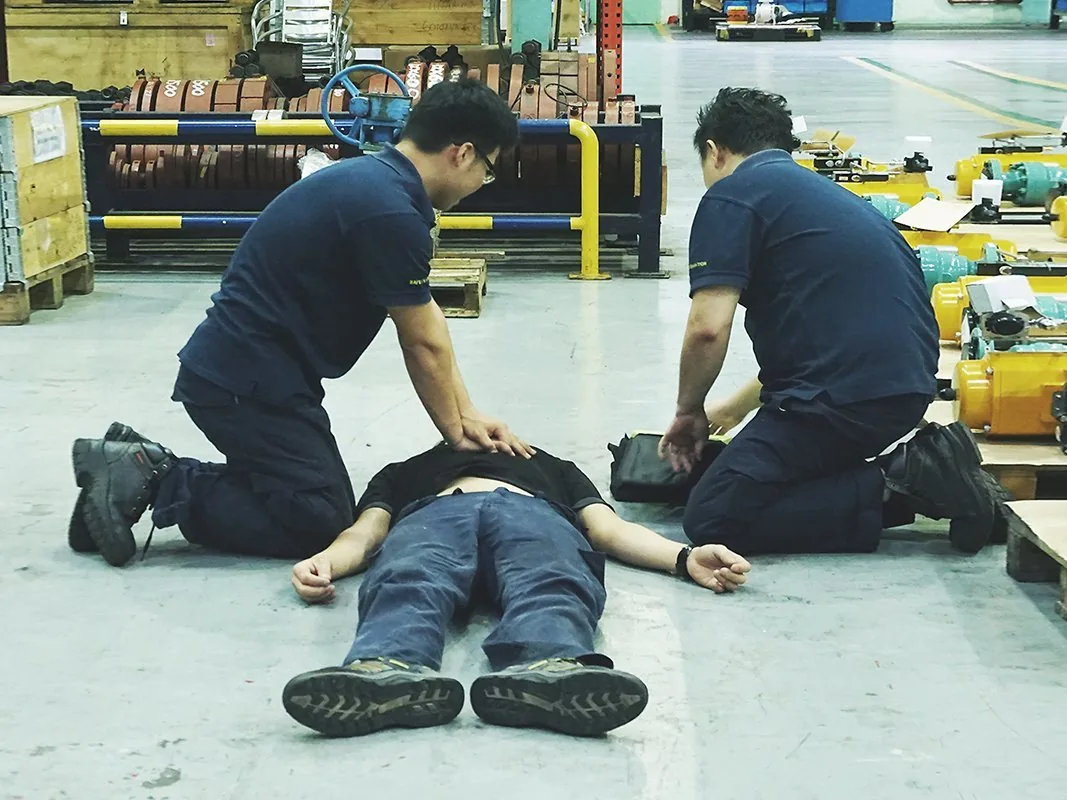
Medlink publishes the course content for Occupational First Aid as eleven areas. The last three are what separate it from a general first aid certificate:
- Essentials of first aid.
- Unconscious casualty (non-cardiac arrest).
- Respiratory problems.
- Shock, bleeding and wounds.
- Musculoskeletal injuries — theory.
- Occupational eye injuries.
- Other first aid knowledge.
- CPR (Hands-Only) + AED — theory.
- First aid requirements in factories and other workplaces.
- Industrial toxicology.
- Safety and accident prevention.
Entry requirements and health notes. Entry is set at ESS Workplace Literacy and Numeracy Level 5 and above. Trainees must be physically fit, since part of the assessment calls for two minutes of continuous chest compressions; anyone with back, knee, spinal, joint, heart or lung conditions should speak to a doctor first, and trainees who are or may be pregnant are advised to enrol after maternity leave.
| Component | Requirement |
|---|---|
| Theory paper | 40 multiple-choice questions, three attempts allowed |
| — Occupational First Aid | 20 questions, 70% to pass |
| — CPR (Hands-Only) + AED | 20 questions, 80% to pass |
| Practical | CPR (Hands-Only) + AED; bandaging of head, trunk and limbs |
| Oral | Scenario-based, three attempts allowed |
| Attendance | 100% required to be eligible for assessment |
Source: Medlink Healthcare Group, Occupational First Aid course page, read 23 September 2026.
Certification
What the course awards on successful completion.
1
Occupational First Aid Provider Certificate
Recognised by the Ministry of Manpower, and the certificate a named occupational first aider is appointed on.
2
CPR (Hands-Only) + AED Provider Certificate
Accredited by SRFAC, covering the resuscitation component of the course.
Both certificates are valid for two years and are issued in credit-card format. Our OFA courses are delivered under an ISO 29993-certified Learning Service Provider framework certified by GIC and compliant with MOM requirements.
Key takeaway: Occupational First Aid is a workplace course, not a longer first aid course. Three of its eleven content areas — eye injuries, toxicology and accident prevention — exist only because the casualty is at work.
Accreditation
Recognition
13
How to arrange Occupational First Aid training with Medlink
Quick Answer: Booking takes four steps: count headcount per shift, work out the number of first aiders required, sort main course from refresher, then confirm dates. Medlink Healthcare Group delivers first aid training alongside its licensed clinical services.
- Count per shift, not per payroll. The ratio applies to the persons employed on each shift.
- Apply the ratio and round up. One first aider per 100 persons employed, or part thereof, once you exceed 25 employees.
- Sort main course from refresher. New appointees take the 23-hour-30-minute course; those inside their two-year validity take the refresher.
- Confirm dates and group sizes. Class size caps at 18, and manikin practice runs at one facilitator to six.
Covering an event or a shutdown as well? Trained first aiders and on-site medical cover answer different problems — Medlink’s ambulance services handle the second. For dates and a GST-inclusive quotation, contact the training team.
Key takeaway: Do the shift arithmetic before you request a quotation. The headcount decides the number of seats, not the other way round.
14
Your next move: count the headcount, then count the first aiders
Quick Answer: An occupational first aid course Singapore workplaces book is a compliance instrument first and a skills course second. Twenty-three and a half hours, two-year validity, a 1:100 ratio above 25 employees, and a notice on the wall with real names.
The framework is simple but unforgiving about dates and arithmetic. Most shortfalls are not training failures — they are a shift roster nobody re-counted after headcount grew, or a certificate that expired while the name stayed on the board.
Two actions close that gap: recount the requirement against current shift headcount this quarter, and put every OFA expiry date into the calendar you already use for equipment inspections.
15
Frequently asked questions
Twenty-three hours 30 minutes for the main course, including 2 hours 40 minutes of assessment. The refresher runs 17 hours 30 minutes with the same assessment block, per the WSH Council Technical Notes.
Two years. The WSH Council Technical Notes set the validity for both CPR + AED and OFA at two years, and require the safety pass or certificate to be issued no later than one month after assessment.
Where more than 25 persons are employed, one first aider is required per 100 persons employed, or part thereof. A 260-person site needs three. Under shift work, the same ratio applies on each shift.
Learners must pass the theory, practical and oral examinations. The passing rate is 70% for the occupational first aid questions and 80% for the CPR and AED questions. Failing CPR and AED means retaking the whole course.
No. Standard First Aid is one of four basic courses accredited by SRFAC. Occupational First Aid is governed by MOM and the WSH Council and adds workplace modules such as industrial toxicology and occupational eye injuries.
Need to fill first-aider appointments this quarter?
Send us your shift headcount and any existing certificate expiry dates. Our training team will confirm how many seats you need, which learners take the main course versus the refresher, and the GST-inclusive fee.
More From Medlink
Popular first aid courses
Explore other SRFAC and SWDA-accredited courses run by our team, from infant care to workplace certification.

Standard First Aid
+ AED
$196.20 incl. GST ($180 before GST)
See Details
Basic First Aid
+ AED
$141.70 incl. GST ($130 before GST)
See Details Occupational First Aid
+ AED
$346.62 incl. GST ($318 before GST)
See Details