Basic First Aid + AED
Basic First Aid + AED Course Singapore
Last updated: 20 August 2026
8 hours · 1 day
CPR + AED component SRFAC-accredited
TL;DR: A basic first aid and AED course in Singapore builds the first reflexes: call 995, start compressions, fetch the AED. “Basic First Aid + AED” is not one of the four course titles SRFAC accredits, but its CPR + AED component is, so you still leave with two certificates: a CPR (Hands-Only) + AED Provider Certificate and a Basic First Aid Certificate of Participation, both valid two years. Neither appoints you as a workplace first aider.
Basic First Aid + AED Course
Click a card to flip and view key details
Most people who freeze in a medical emergency are not unwilling. They have simply never rehearsed the first ninety seconds, so the body waits for someone else to move.
An introductory session exists to remove that pause. This page sets out what basic first aid and AED training teaches, where it sits against the accredited courses, and what Singapore law does and does not accept it for. Every figure below comes from SRFAC, MOM, SCDF or Singapore Statutes Online.
1
What the basic first aid and AED course covers
Quick Answer: This introductory course covers the opening moves of an emergency — checking for danger, calling 995, starting chest compressions, and switching on an automated external defibrillator. It is an awareness session built around one question: what do you do in the first two minutes?
The scope is deliberately narrow. Rather than teach a full injury syllabus, the session concentrates on the sequence a bystander has to get right before anyone qualified arrives.
- The primary survey. MOM teaches the DRSABC sequence — Danger, Response, Shout for help, AED, Breathing, Chest compressions — as the backbone of a workplace emergency action plan.
- Calling for help properly. MOM’s casualty response has the caller stay on the line with SCDF rather than hang up and improvise.
- Chest compressions. Hand position, depth, and the habit of not stopping.
- AED familiarisation. Opening the case, following the voice prompts, standing clear on command.
That is the whole design. It is a floor, not a qualification — which is why the Standard First Aid course exists above it.
Key takeaway: This session teaches the opening sequence of an emergency, not a full first aid syllabus. Judge it on whether your people can start, not on what they can treat.
2
What this course certifies, and what it does not
Quick Answer: SRFAC accredits four basic courses: BCLS+AED, CPR(Hands-Only)+AED, Standard First Aid and Child First Aid. “Basic First Aid + AED” is not one of those titles, but its CPR + AED component is accredited and assessed. Pass the assessment and Medlink issues an SRFAC CPR (Hands-Only) + AED Provider Certificate plus a Basic First Aid Certificate of Participation, both valid two years.
SRFAC publishes the official list of accredited course titles, and requires certificates from accredited training centres to carry the exact title plus the words “Accredited by Singapore Resuscitation and First Aid Council”. A course outside that list cannot carry those words — which is why the accredited certificate you receive names the CPR (Hands-Only) + AED component rather than “Basic First Aid + AED”.
Being clear about this protects you. If a tender, licence condition or insurer names Standard First Aid, BCLS+AED or another accredited course title, this course will not satisfy it — and finding that out after the training day is the expensive way to learn it.
- Two certificates, one of them accredited. The CPR (Hands-Only) + AED Provider Certificate is issued under SRFAC accreditation. The Basic First Aid Certificate of Participation covers the wider first aid content and is Medlink’s own.
- Both run for two years. Medlink issues both certificates with a two-year validity, so there is a renewal date to diarise.
- No entry credit. SRFAC has required a valid BCLS+AED Provider certificate since 1 May 2023 for enrolment into its advanced courses. A CPR (Hands-Only) + AED Provider Certificate is not a BCLS+AED one, so neither certificate from this course counts towards that.
If any of those three matter, book CPR(Hands-Only)+AED or Standard First Aid instead. If none do, this session is doing the job it was built for.
Key takeaway: Accreditation is a yes-or-no question, and for this course the answer is no. Match the course to the requirement in writing before you book.
Not sure which course your requirement actually names?
The pillar guide sets out how the SRFAC course family fits together and which one each obligation points to. Compare the SRFAC first aid courses →
3
What Singapore law asks of a workplace, and where this course fits
Quick Answer: The Workplace Safety and Health (First-Aid) Regulations require appointed first aiders where more than 25 persons are employed, at one first aider for every 100 persons employed. Those first aiders must have completed a training course acceptable to the Commissioner, which an awareness session is not.
The regulations are short and specific. Reading them once tells you which duties an awareness session touches, and which it cannot.
| Regulation | What it requires | Does this course satisfy it? |
|---|---|---|
| Reg 4 — first-aid boxes | A sufficient number per workplace and per floor, adequately equipped and checked frequently | Not a training duty |
| Reg 5(1) — first aiders | Where more than 25 persons are employed, one first aider for every 100 persons employed | No — needs an accredited first aid course |
| Reg 5(2) — training standard | A first aider must have completed a course acceptable to the Commissioner, plus re-training as required | No — this is not that course |
| Reg 5(3) — shift cover | The same ratio applies on every shift | No, but it raises the shift baseline |
| Reg 6 — first-aid room | Required where more than 500 persons are at work | Not a training duty |
Source: Workplace Safety and Health (First-Aid) Regulations, Singapore Statutes Online.
The penalties are real. An occupier who fails to comply with those duties is liable on conviction to a fine not exceeding $20,000 or imprisonment not exceeding two years, or both, rising to $50,000 for a repeat offender.
So the honest framing is this: an awareness session raises a team’s general capability. Your named first aiders still need Standard First Aid, kept current through the Standard First Aid refresher course.
Key takeaway: The law names appointed first aiders, not trained bystanders. Use this course to widen the base, and an accredited course to fill the named roles.
4
Where first aid gets used: Singapore workplace injury rates in 2025
Quick Answer: Singapore’s workplace fatal injury rate fell to 0.96 per 100,000 workers in 2025, with a major injury rate of 15.7 excluding platform workers. Sector rates diverge sharply, and platform workers recorded a fatal and major injury rate of 84.6 per 100,000.
National averages hide the sectors that need trained bystanders most. The major injury rate rises to 17.7 per 100,000 once platform workers are counted, and by sector the picture changes again.
| Platform workers | 84.6 | |
| Metalworking | 36.0 | |
| Manufacturing | 28.8 | |
| Construction | 26.3 | |
| Transportation & Storage | 23.8 |
Source: Ministry of Manpower, Workplace Safety and Health Report 2025. Bar lengths are proportional to the platform worker rate.
Direction matters as much as level. Construction fell from 31.0 in 2024 to 26.3 in 2025, and metalworking from 46.4 to 36.0. Transportation and storage moved the other way, rising from 18.4 to 23.8, with vehicular incidents and slips a leading cause.
Platform workers are the outlier for a structural reason: they work on public roads and paths with limited control over their environment. MOM recorded 2 fatalities and 74 major injuries among them in 2025, the first year such data was collected.
Key takeaway: The national rate tells you little about your own risk. Check your sector’s rate, then decide how deep your team’s training needs to run.
5
The minutes before the ambulance arrives
Quick Answer: More than 2,300 Singaporeans suffer cardiac arrest each year, only 3 per cent survive, and the chance falls 7 to 10 per cent every minute. Bystander CPR doubles survival rates, which is the whole reason an awareness course exists.
SCDF publishes both halves of this picture: the demand the system carries, and how much of the outcome rests on whoever is standing closest.
| Measure | Figure |
|---|---|
| The demand | |
| SCDF emergency medical service calls, 2025 | 257,158 (up 4.8% on 2024) |
| Daily average EMS calls, 2025 | 705 |
| The clock | |
| Cardiac arrests in Singapore each year | More than 2,300 |
| Survival rate | 3% |
| Fall in survival chance per minute | 7% to 10% |
| Effect of bystander CPR | Doubles survival rates |
| The bystander | |
| Community First Responder response rate, 2024 | 50.3% |
| Community First Responder response rate, 2025 | 72.4% |
| New myResponder sign-ups, 2025 | 47,240 (up 17.4% on 2024) |
Sources: SCDF Emergency Medical Services, Fire and Enforcement Statistics 2025; SCDF Save-A-Life.
Read together, the three groups make the case. Demand is rising, the survival window closes in minutes, and the one variable a company can move is whether its own people start.
Key takeaway: Ambulances cannot beat the survival clock on their own. The person already in the room is the variable, and training is how you change it.
6
What the AED portion teaches a complete beginner
Quick Answer: The AED portion of this course removes hesitation rather than teaching diagnosis. The device analyses the heart rhythm and decides whether to shock. The learner’s job is to fetch it, switch it on, place the pads and follow the voice prompts.
Most first-time learners arrive worried about doing harm. MOM’s guidance answers those fears directly, and repeating the answers out loud is much of what the session achieves.
- Pads go on a bare chest. MOM notes clothing can be slit to reach the skin, and that scissors are included in every AED set.
- Swapped pads are recoverable. If the top-right and bottom-left pads are exchanged, the AED still reads the rhythm and works as usual.
- Brand does not matter. MOM states there is no preferred brand and all brands work equally well — useful when the AED on the wall is not the one you trained on.
- Broken ribs are not a fault. MOM’s guidance is that you will not be faulted, and the rule of thumb is to compress one third of the body depth.
- Pregnancy is not a reason to hold back. CPR and AED use are both appropriate, because saving the mother is how the baby is saved.
None of that is complicated. It is simply not obvious to someone who has never been shown, and unfamiliarity produces the pause. For an assessed version of the same skills, the CPR + AED course is the accredited next step.
Key takeaway: The AED makes the clinical decision. Training exists so nobody hesitates long enough for that decision to stop mattering.
Planning first aid cover across a whole site?
Awareness training, accredited first aiders and standby medical cover often need to be scoped together. See our ambulance and medical standby services →
7
The medical emergencies a workplace session should cover
Quick Answer: MOM lists nine common workplace medical emergencies: fainting, heat injuries, burns, bleeding, sprains, fractures and dislocations, stroke, fits and seizures, and cardiac arrest. An awareness session covers recognition and first response, not definitive treatment.
That list is a scoping tool. Run it against your own site and you will see whether an awareness session is enough, or whether you need accredited first aiders on every shift.
MOM also teaches two memory aids that make recognition faster.
- F.A.S.T., for stroke. Facial drooping, Arms weakness, Speech difficulties, Time to call emergency.
- SAMPLE, for the wider assessment. Signs and symptoms, Allergies, Medications, Past medical history, Last meal, Events leading up to the injury.
A kitchen meets burns and bleeding. A warehouse meets fractures and heat injuries. An office meets fainting, stroke and cardiac arrest. Your hazard profile sets the honest training depth, which is why the Standard First Aid syllabus runs wider than this one.
Key takeaway: Score MOM’s nine emergencies against your own site. The ones you can realistically expect should set your training depth.
8
How the session runs, and what you receive
Quick Answer: Medlink delivers the basic first aid and AED course at our training premises or at your own site, using manikins and trainer AED units. Attendance is recorded for your training file, and the CPR + AED assessment at the end issues an SRFAC CPR (Hands-Only) + AED Provider Certificate alongside a Basic First Aid Certificate of Participation.
Three practical points cover most enquiries.
- Venue. On-site delivery suits shift teams who cannot leave together; classroom delivery suits mixed groups from several offices.
- Equipment. Manikins for compressions, and trainer AED units that speak the same prompts as a live device, so the first real AED a learner opens is not a surprise.
- Documentation. Attendance is recorded so your organisation can evidence the session internally. It is not certification, and the paperwork says so plainly.
Fees are quoted per group and stated inclusive of GST, so the figure you approve is the figure you pay. SkillsFuture Credit applies only to courses listed on the MySkillsFuture course directory; an awareness session sits outside that directory, so it is not fundable.
Key takeaway: Expect a practical session with real equipment, a GST-inclusive group quote, an assessment at the end — and two certificates valid two years. Budget accordingly.
9
Choosing between this course and an accredited one
Quick Answer: Choose this course when nothing in writing names an accredited course title and you want to lift a whole team’s baseline. Choose an SRFAC-accredited course when a regulation, contract, licence or insurer names a qualification, or when someone is being appointed as a workplace first aider.
One question separates the two paths: does anything in writing name a certificate?
| Your situation | The course that fits |
|---|---|
| General staff, no accredited course title required | Basic First Aid + AED (this page) |
| Want an accredited resuscitation certificate without a wider first aid scope | CPR(Hands-Only)+AED |
| Being appointed as a workplace first aider under Reg 5 | Standard First Aid |
| Already an appointed first aider, certificate approaching expiry | Standard First Aid refresher |
| Higher-risk site needing first aiders trained to occupational scope | Occupational First Aid + AED |
A workable pattern is to run both: an awareness session for the whole department so nobody stands still, and accredited training for the named first aiders the regulations require.
Key takeaway: Awareness training and accredited training solve different problems. Most sites need some of each rather than one or the other.
Need the accredited course instead?
If your requirement names an accredited course title, start with the SRFAC-accredited option rather than this course. See the Standard First Aid course →
10
Inside Medlink’s Basic First Aid + AED course
Quick Answer: Medlink runs Basic First Aid + AED as one eight-hour day at 30 Sam Leong Road, covering choking, minor wounds, burns, fractures and cardiac arrest. Only the CPR + AED component is SRFAC-accredited, and that is the component the formal assessment covers.
Medlink publishes the course content as five areas:
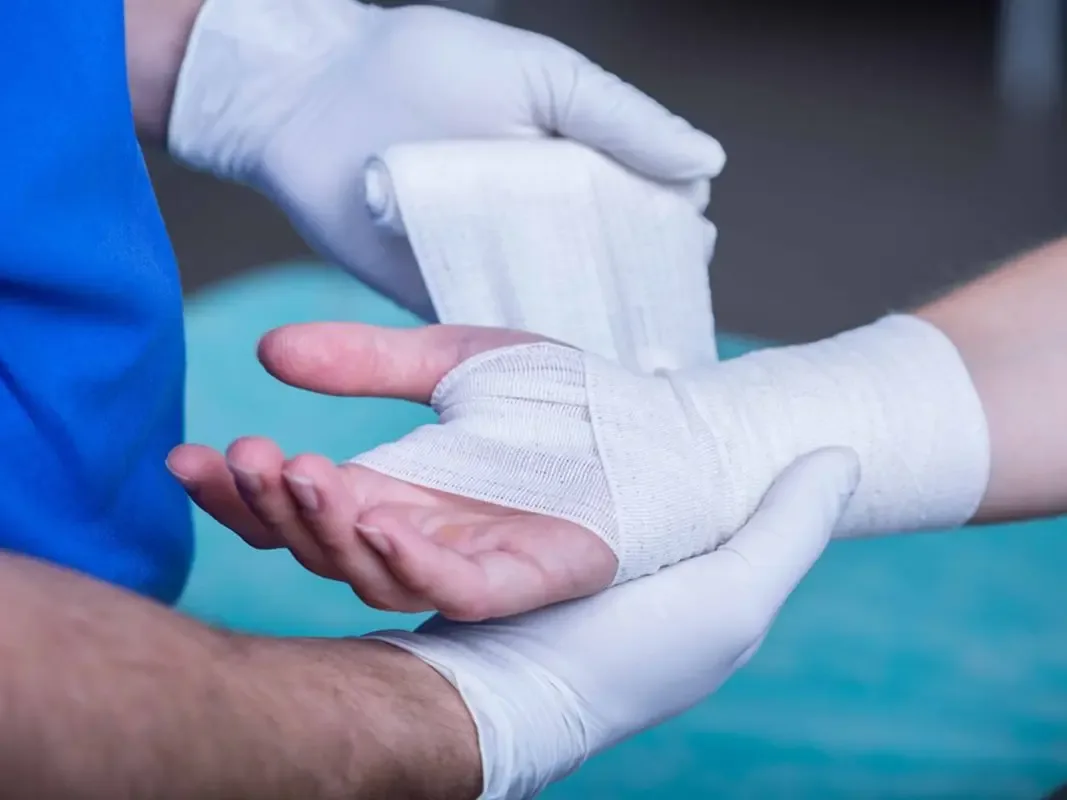
- Choking.
- Minor wounds.
- Burns.
- Fractures.
- Cardiac arrest — applying CPR and using an AED.
Entry requirements and health notes. Trainees need enough English to follow the course and should be physically fit, since part of the assessment calls for two minutes of continuous chest compressions and ventilations. Anyone with back, knee, spinal, joint, heart or lung conditions should consult a doctor first, and trainees who are or may be pregnant are advised to enrol after maternity leave.
| Component | Requirement |
|---|---|
| Theory paper | 10 multiple-choice questions on CPR (Hands-Only) + AED, 80% to pass |
| Duration of paper | One hour, three attempts allowed |
| Practical | Scenario-based; a 100% score is required to pass |
| Attendance | 100% required to be eligible for assessment |
| Results | Released on the day of training, or within two working days |
Source: Medlink Healthcare Group, Basic First Aid + AED course page, read 23 September 2026.
Certification
What the course awards on successful completion.
1
Basic First Aid Certificate of Participation
Issued by Medlink for the first aid content. It is not an SRFAC provider certificate and does not appoint you as a workplace first aider.
2
CPR (Hands-Only) + AED Provider Certificate
The accredited part. SRFAC accredits the CPR + AED component only, and this certificate is valid for two years.
Read the split carefully. Only the CPR + AED component is accredited by SRFAC. If your obligation names a first aid certificate, the accredited routes are Standard First Aid or Occupational First Aid.
Key takeaway: One day, five emergencies, and one accredited certificate out of two. The CPR + AED half is the half a regulator will recognise.
Accreditation
11
How to arrange training with Medlink
Quick Answer: Tell us your group size, your site’s hazard profile, and whether anything in writing requires a certificate. We will confirm whether this introductory course is the right fit, or whether an accredited course is the one you need.
Medlink is a Singapore healthcare group spanning first aid training, industrial paramedicine — on-site clinical cover for worksites — and HCSA-licensed ambulance services. The team that teaches the awareness session also staffs the vehicles that respond when awareness is not enough.
- Send the requirement, not just the course name. The tender clause, licence condition or insurer’s wording tells us more than a course title does.
- Tell us the group shape. Headcount, shift pattern, and whether the group needs to stay on site.
- Ask about combined scoping. Training, first aid provisioning and medical standby cover are often planned in one conversation.
Reach the training team through the Medlink contact page, or browse the full course range on the Medlink Healthcare Group site.
Key takeaway: Lead with the requirement and the group shape. Those two facts decide the course faster than any brochure can.
12
Conclusion: a starting point, described honestly
Quick Answer: A basic first aid and AED course in Singapore is an introductory session that teaches the first two minutes of an emergency. It is not one of SRFAC’s four accredited course titles, though its CPR + AED component is accredited and certificated, and it appoints no workplace first aiders — but it does remove the pause that costs survival.
Singapore’s cardiac arrest survival rate is 3 per cent, and bystander CPR doubles it. That single fact is what an awareness session is built around.
If your obligation names an accredited course title, take the accredited route through Standard First Aid or CPR + AED. If not, and you want more people in the building who will move first, start here.
13
Frequently asked questions
No. SRFAC accredits four basic courses — BCLS+AED, CPR(Hands-Only)+AED, Standard First Aid and Child First Aid. Basic First Aid + AED is not on that list, so it does not carry an SRFAC course title. Its CPR + AED component is accredited, and passing that assessment issues an SRFAC CPR (Hands-Only) + AED Provider Certificate valid two years, alongside a Basic First Aid Certificate of Participation.
No. The Workplace Safety and Health (First-Aid) Regulations require appointed first aiders where more than 25 persons are employed, at one for every 100 persons employed. Each must have completed a training course acceptable to the Commissioner, and an awareness session does not meet that standard.
No. SkillsFuture Credit applies to courses listed on the MySkillsFuture course directory. An awareness session is not listed there, so it cannot be claimed against.
Yes — two. A CPR (Hands-Only) + AED Provider Certificate, issued after the assessment, and a Basic First Aid Certificate of Participation. Both are valid two years. If you attend but opt out of the CPR + AED assessment, you receive a Certificate of Attendance instead.
CPR(Hands-Only)+AED is one of SRFAC’s four accredited basic courses, with a set syllabus, formal theory and practical assessments, and a certificate. Basic First Aid + AED covers a wider set of first aid topics, and only its CPR + AED component is SRFAC-accredited and assessed.
Yes. Sessions run at your own premises or at a Medlink training venue, with manikins and trainer AED units brought on site. Send your group size and shift pattern and we will confirm what fits.
Ready to arrange first aid training for your team?
Tell us your group size, your site’s hazards, and whether anything in writing names a certificate. We will confirm the right course, the available dates and a GST-inclusive quote.
More From Medlink
Popular first aid courses
Explore other SRFAC and SWDA-accredited courses run by our team, from infant care to workplace certification.
Standard First Aid
+ AED
$196.20 incl. GST ($180 before GST)
See Details Basic First Aid
+ AED
$141.70 incl. GST ($130 before GST)
See Details
Occupational First Aid
+ AED
$346.62 incl. GST ($318 before GST)
See Details