Ambulance Services in Singapore
TL;DR: Call 995 for life-threatening emergencies. For planned or non-emergency transport such as appointments, dialysis, discharges and inter-facility transfers, a licensed private ambulance applies. Medlink operates emergency and medical transport vehicles 24 hours a day, with published fees from $125.35 for a one-way non-emergency transfer.
All prices are displayed inclusive of GST
Emergency Transport
$256.15
One Way Transfer
$125.35
Two Way Transfer
$212.55
Terminal Discharge
$381.50
Priority booking fee: +$21.80 for eligible bookings within 2 hours. Additional surcharges may apply.
Singapore’s ambulance system splits along one line: emergency and everything else. SCDF handles the first. Licensed private operators handle the second.
That division is about to matter more. SCDF is closing its 1777 non-emergency ambulance hotline on 1 January 2027 and directing the public to private operators instead. This page explains which service applies to which situation, what the two Ministry of Health licence classes cover, who is on board, and what it costs.
When to call 995 and when to book a private ambulance
Quick Answer: Call 995 for cardiac arrest, stroke, severe breathing difficulty, major trauma, unconsciousness or uncontrolled bleeding. Book a private ambulance for stable patients needing planned transport such as appointments, dialysis, discharge, or transfer to a specific hospital. Our 24-hour operations line takes both urgent and advance bookings.
SCDF is explicit about what its emergency service is for. Its published examples of emergencies are cardiac arrest, seizures, breathlessness, loss of consciousness, excessive bleeding, major traumas and stroke. Its examples of non-emergencies are toothaches, diarrhoea, coughs, headaches, slight burns, constipation and medical check-ups.
Three consequences follow from calling the wrong one:
Since April 2019, SCDF does not convey non-emergency cases to hospital. Callers are advised to see a GP instead.
A non-emergency conveyance is chargeable. SCDF charges $274 for each non-emergency case it does convey. Emergency conveyances are free.
You do not choose the hospital. SCDF conveys only to the nearest appropriate MOH-designated hospital by travel time.
That last point drives a large share of private bookings. A patient under a consultant at a specific hospital, or one whose records sit with a particular institution, often needs to reach that hospital rather than the closest one.
Key takeaway: 995 decides the destination for you. A private ambulance lets you name it, provided the patient is clinically stable enough for the receiving hospital to accept them.
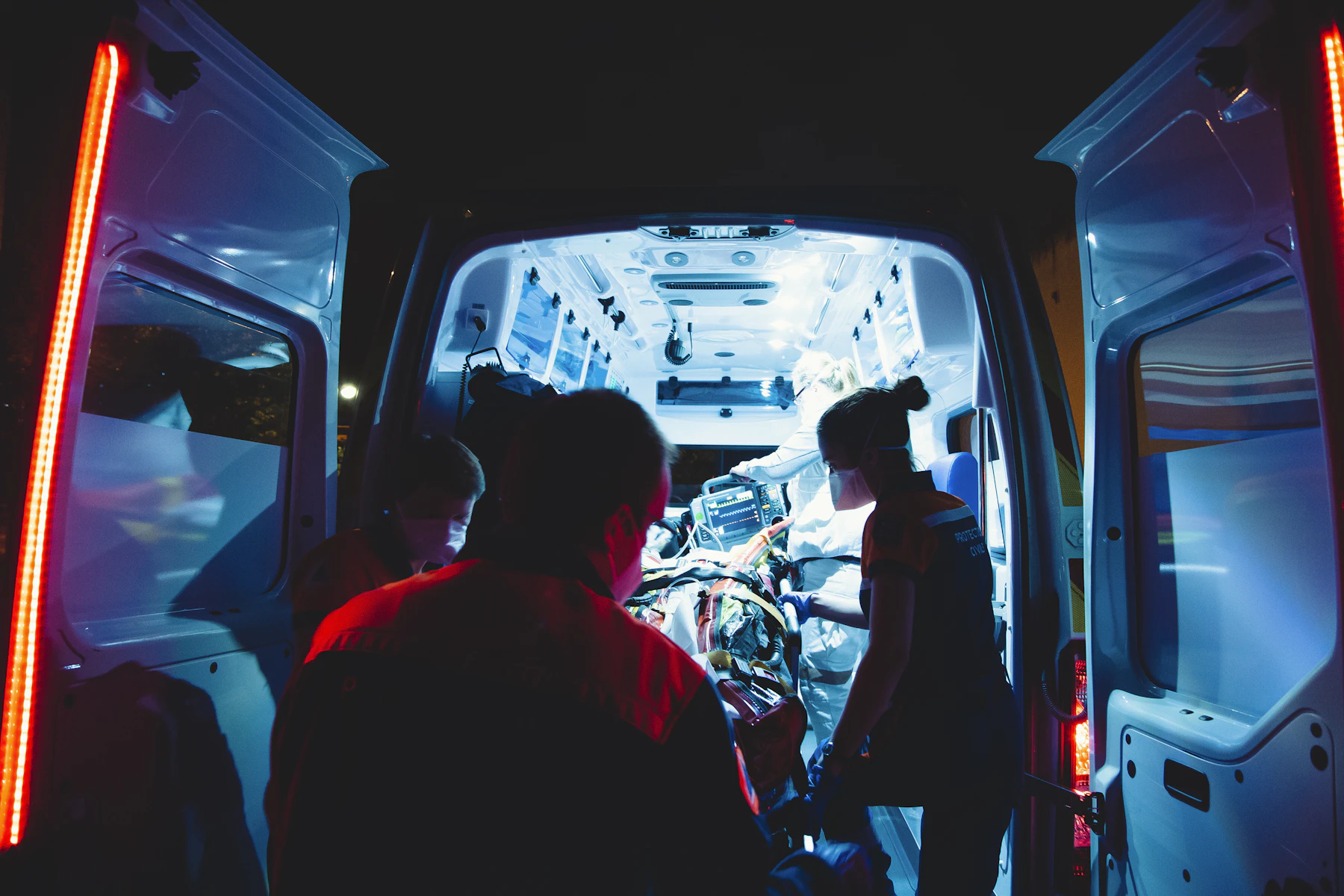
Arranging a discharge or an appointment transfer?
Advance bookings are confirmed against your preferred date and time.
Book a non-emergency transferWhat the two MOH licence classes actually cover
Quick Answer: Private ambulances in Singapore operate under two licence classes in the Healthcare Services Act: Emergency Ambulance Service and Medical Transport Service. EAS covers conveyance of emergency patients with clinical care and monitoring en route. MTS covers non-emergency conveyance. Medlink holds both, alongside its medical support division.
Since 3 January 2022, providing private emergency ambulance or medical transport services in Singapore without a valid licence has been an offence. Both classes sit under MOH’s clinical support services group.
| Emergency Ambulance Service | Medical Transport Service | |
|---|---|---|
| Patient type | Any patient, including emergency patients | Non-emergency, clinically stable |
| Care en route | Clinical care and monitoring throughout | Conveyance and basic support |
| Typical use | Acute deterioration, urgent A&E conveyance, standby cover | Appointments, dialysis, discharge, inter-facility transfer |
| Clinical Governance Officer | SMC-registered doctor; specialist in anaesthesiology, emergency medicine, general surgery or intensive care, or 10+ years in those fields; valid ACLS certification | Required under the same Regulations |
| Vehicle marking | Must bear “EMERGENCY AMBULANCE” front, rear and both sides | Not applicable |
| Patient compartment | Minimum 2.9 m × 1.5 m × 1.3 m | Per Regulations |
Sources: MOH, Emergency Ambulance Service and Medical Transport Service licensing pages; Healthcare Services (Emergency Ambulance Service and Medical Transport Service) Regulations 2022.
One practical consequence: because Medlink mainly runs emergency-equipped vehicles, an emergency ambulance may arrive for a booking made as non-emergency transport. That is deliberate: it means the crew is equipped if the patient’s condition changes. Billing follows the service booked, not the vehicle sent.
Key takeaway: Check that any operator you book holds the licence class matching your need. The distinction is legal, not marketing, and it determines what the crew is permitted to do en route.
What the 1777 closure means from January 2027
Quick Answer: SCDF will cease the 1777 non-emergency ambulance hotline on 1 January 2027. Members of the public needing non-emergency conveyance will contact private ambulance operators directly, and those wanting medical advice will call NurseFirst on 6262 6262. Medlink’s operations line takes bookings around the clock; see contact details.
MOH announced the closure on 1 July 2026. The hotline was introduced in 1998 as a referral point for non-emergency transport, but only about 6% of private operator bookings are now made through it. The rest already go direct.
What changes for the public
Non-emergency conveyance
Contact a private ambulance operator directly. MOH publishes operator contacts and fees at go.gov.sg/pao.
Medical advice for non-emergency conditions
Call NurseFirst on 6262 6262 to speak with a registered nurse.
995 is unaffected
Calls assessed as non-emergency will be referred to NurseFirst for advice.
The wider context is demand. SCDF handled a record volume in 2025, and expects it to keep climbing.
| Measure | 2024 | 2025 | Change |
|---|---|---|---|
| Total EMS calls | 245,279 | 257,158 | +4.8% |
| Average calls per day | 672 | 705 | +33 |
| Of which emergency | n/a | 239,855 (93.3%) | n/a |
| Of which non-emergency | n/a | 11,064 (4.3%) | n/a |
| Of which false alarm | n/a | 6,239 (2.4%) | n/a |
| Calls involving seniors aged 65+ | n/a | 49.7% | n/a |
Source: SCDF, Annual Statistics on EMS, Fire & Enforcement 2025. Daily 2024 figure derived from total. SCDF notes demand is expected to keep rising over the next five years, largely from an ageing population.
Key takeaway: Nearly half of Singapore’s emergency ambulance calls now involve seniors. Families managing regular hospital appointments for an elderly relative should establish a private transport arrangement before 1777 closes.
Who is on board and what they are trained to do
Quick Answer: A licensed emergency ambulance is crewed by paramedics and emergency medical technicians working to a defined scope of practice set by MOH. Both must recertify at least once every two years. Our crews come from the same clinical background as our BCLS instruction team.
The Emergency Ambulance Service licence conditions specify exactly what each crew role may do. The difference is not seniority; it is the range of clinical interventions permitted en route.
| Intervention | EMT | Paramedic |
|---|---|---|
| Vital signs monitoring | Yes | Yes |
| Bag valve mask ventilation | Yes | Yes |
| Independently initiating an AED | Yes | Yes |
| Oxygen administration | Under protocol | Yes |
| 12-lead ECG with transmission to receiving hospital | No | Yes |
| IV access and designated IV medications | Monitoring only | Yes |
| Advanced airway adjuncts including LMA | No | Yes |
| Blood glucose test and hypoglycaemia treatment | Yes | Yes |
| Emergency childbirth | Assists | Trained crew |
| Recertification interval | Every 2 years | Every 2 years |
Source: MOH, Licence Conditions for Emergency Ambulance Service, 3 January 2022.
Two further requirements sit behind the crew. The Clinical Governance Officer must write care protocols covering, at minimum, cardiac arrest, seizures, shortness of breath, loss of consciousness, sudden weakness, stroke, chest pain and severe abdominal pain. And the crew leader must be positioned next to the patient at all times during conveyance.
What a licensed emergency ambulance carries
Quick Answer: MOH sets a mandatory equipment list for every licensed emergency ambulance in Singapore, covering airway, circulation, immobilisation, monitoring and a defined drug inventory. Operators may exceed it but not fall below it. The same clinical standards inform our on-site medical cover.
The equipment schedule runs to nine categories. The items below are the mandated minimums, not a supplier’s brochure:
-
Airway and breathing.
Portable and fixed suction with regulator; portable oxygen with metered flow; bag valve masks in adult (over 1,000 ml) and child (450–750 ml) sizes; oropharyngeal airways in sizes 40 mm to 100 mm.
-
Cardiac.
A portable battery-operated defibrillator with paediatric capability, including child-sized pads.
-
Monitoring.
Continuous cardiac rhythm, blood pressure and oxygen saturation; a glucometer.
-
Trauma and immobilisation.
Cervical collars, pelvic immobiliser, backboards, arterial windlass tourniquet.
-
Medications, minimum two doses each.
Nitroglycerin, aspirin 300 mg, salbutamol, dextrose 10%, adrenaline, a non-opioid analgesic, and an anti-seizure medication.
Medlink’s fleet adds wheelchair lifters on ten vehicles, electric stretchers rated for bariatric patients, and stretchers supporting up to 318 kg.
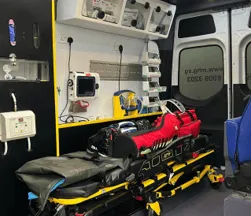
Inside a Medlink ambulance
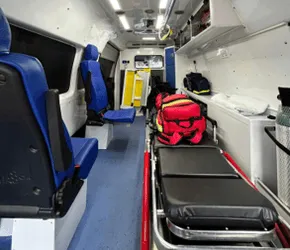
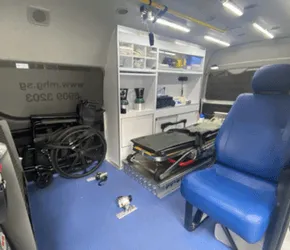
Key takeaway: Every licensed emergency ambulance in Singapore carries the same clinical floor. When comparing operators, the useful questions are vehicle accessibility, patient weight limits and crew availability, not whether a defibrillator is on board.
Ambulance fees and how they compare to the market
Quick Answer: Medlink’s published fees are $125.35 for a one-way non-emergency transfer, $212.55 two-way, $256.15 for emergency transport, and $381.50 for a terminal discharge, all inclusive of GST. Surcharges apply for after-hours, waiting time, stairs and specialist equipment. Request a full quotation.
| Service | Medlink fee | Included |
|---|---|---|
| One-way transfer (non-emergency) | $125.35 | Up to 15 minutes waiting time |
| Two-way transfer (non-emergency) | $212.55 | Up to 15 minutes waiting time |
| Emergency transport | $256.15 | Life-saving intervention including medication; arrival 30–45 minutes on acceptance. Oxygen is not included and is charged separately (see add-on surcharges below) |
| Terminal discharge | $381.50 | Up to 30 minutes waiting time on arrival |
| Medical escort (medic, paramedic or nurse) | $59.95 / hr | Minimum 2-hour block |
| Medical escort (doctor) | $523.20 / hr | Minimum 2-hour block |
| Priority fee | $21.80 | Bookings made within 2 hours or less |
| MOH-published market range, one-way to A&E, office hours | $70 – $600 | Median $175 (MTS), $230 (EAS) |
All Medlink fees inclusive of GST. Market range and medians from MOH, Private Ambulance Services, fees as at January 2026. MOH states these published fees are neither guided nor endorsed by the Ministry. Surcharges apply for after-hours transfers, extended waiting, staircase access, bariatric transfers, specialist equipment and certain locations.
Bariatric Transfer Options
For patients above 80 kg, an additional charge applies per trip on top of the base transfer fee above. Select a weight band and transfer type to see the surcharge.
Surcharges are per trip and inclusive of GST, charged in addition to the base transfer fee. Patients above 299 kg are assessed individually; call the operations line for a quotation.
Services Add-On Surcharges
These are charged on top of the base transfer fee where they apply. Each one is quoted on the invoice, so you can see what was added and why.
| Surcharge | Charged | Price (SGD) |
|---|---|---|
| Staircase surcharge | Per flight, minimum 3 steps | $16.35 |
| Provision of oxygen supplement | Per litre | $10.90 |
| Waiting time | Per 30 minutes or part thereof | $49.05 |
| After office hours | Outside Mon–Fri 0800–1800H and Sat 0800–1200H, and on public holidays | $54.50 |
| High risk surcharge | Per trip | $109.00 |
| Provision of syringe or infusion pumps | Per equipment | $299.75 |
| Provision of ventilator | Per equipment | $1,188.10 |
| Priority fee | Bookings made within 2 hours or less | $21.80 |
All surcharges inclusive of GST. Location surcharges apply separately for psychiatric facilities, airport and seaport transfers, tarmac access and cross-border land transfers; call the operations line for those.
Whether your policy covers ambulance charges depends on its terms; check directly with your insurer. Medlink can issue an itemised invoice and service documents to support a claim.
Key takeaway: The headline transfer fee is rarely the final figure. Bariatric weight, after-hours timing, waiting time and access all add to it, so ask for an itemised quotation before you book.
Frequently asked questions
995 is SCDF’s emergency service, free for genuine emergencies, and conveys only to the nearest appropriate MOH-designated hospital. A private ambulance is chargeable, can be pre-booked or requested urgently, and can convey a clinically suitable patient to a hospital of choice, public or private.
Advance bookings are confirmed for your preferred date and time, subject to availability. Urgent requests are typically 30 to 45 minutes depending on traffic and vehicle availability. Any delay is communicated as soon as it is known.
Yes, to public or private hospitals. Before booking, inform the hospital of the patient’s condition, confirm acceptance, and complete any pre-registration. If the patient deteriorates during transport, the crew may divert to the nearest hospital for stabilisation.
Medlink mainly operates emergency-equipped ambulances so that the crew is prepared if a patient’s condition changes en route. This does not affect what you pay; billing follows the service booked, not the vehicle dispatched.
SCDF does not charge for emergency cases it conveys to hospital. It charges $274 for each non-emergency case it conveys. Since April 2019, SCDF has not conveyed non-emergency cases at all, advising callers to see a GP instead.
From 1 January 2027, non-emergency ambulance bookings are made directly with private operators. For medical advice on non-emergency conditions, the public should call NurseFirst on 6262 6262. The 995 emergency line is unaffected.
Need to arrange an ambulance transfer?
Our operations centre takes bookings 24 hours a day, for both advance appointments and urgent requests. Tell us the patient’s condition, pick-up and destination, and we will confirm availability and the applicable fee.