
Standard First Aid
Standard First Aid Course in Singapore (SFA)
Last updated: 19 August 2026
16 hours · SRFAC syllabus
SkillsFuture funding available
TL;DR: The Standard First Aid course in Singapore is a 16-hour programme accredited by the Singapore Resuscitation and First Aid Council. It covers first aid plus CPR (Hands-Only) and AED, and issues two certificates valid for two years. Medlink runs it for $196.20 including GST, with SkillsFuture funding available.
Standard First Aid Course
Click a card to flip and view key details
Standard First Aid (SFA) is one of Singapore’s most widely recognised first aid certifications. Whether you’re a workplace first-aider, sports coach, teacher, caregiver, or simply want to be prepared for emergencies, this guide explains what the course covers, certification validity, funding eligibility, and legal workplace requirements.
Every figure below comes from a primary source: SRFAC, Sport Singapore, the Skills and Workforce Development Agency (SWDA), or the Workplace Safety and Health Regulations. Each one is linked so you can check it yourself.
1
Who needs a Standard First Aid certificate in Singapore?
Quick Answer: A Standard First Aid (SFA) certificate is required for registered sports coaches under Sport Singapore’s National Registry of Coaches and is widely accepted for workplace first-aider appointments in Singapore. It is also commonly held by teachers, childcare staff, lifeguards, security officers, hotel employees, F&B personnel, and youth uniformed group leaders.
If you work in a higher-risk environment such as construction, manufacturing, or shipyard operations, you may need an Occupational First Aid Course (OFAC) instead of a Standard First Aid certification.
Four groups make up most Standard First Aid enrolments in Singapore:
Registered sports coaches
The National Registry of Coaches requires members to hold a “Valid Standard First Aid (including AED) Certificate” for both admission and renewal. A coach without one is moved to Inactive status.
Appointed workplace first-aiders
Named staff at Singapore workplaces employing more than 25 people, under the Workplace Safety and Health (First-Aid) Regulations.
Education and childcare staff
Teachers and uniformed group leaders. Note that early childhood educators need Child First Aid specifically, not Standard First Aid, to meet ECDA requirements.
Service and hospitality staff
Hotel staff, F&B crew, attractions team members, fitness instructors and lifeguards.
Registered coaches under Sport Singapore’s National Registry of Coaches (NROC) are required to maintain valid Standard First Aid, CPR and AED certification. However, Sport Singapore notes that these courses do not earn Continuing Coach Education (CCE) hours because they are considered baseline requirements for all coaches.
Not sure which first aid course you need?
The right course depends on your role and on how much risk your workplace carries.Tell us what you need the certificate for and our training team will point you to the one that fits — and to the next available date.
Ask us which course you need
2
What the SRFAC Standard First Aid syllabus covers
Quick Answer: The syllabus runs to eight chapters set by the Singapore Resuscitation and First Aid Council, ending with CPR (Hands-Only) and AED. It covers unconscious casualties, respiratory problems, shock and bleeding, musculoskeletal injuries and burns. Medlink is an SRFAC-accredited training centre for this course.
SRFAC is the national body responsible for setting guidelines and accrediting resuscitation and first aid training centres in Singapore. Its syllabus is fixed, and every accredited centre teaches the same eight chapters:
- Essentials of first aid. Scene safety, emergency action principles, activating the emergency response system.
- Unconscious casualty (non-cardiac arrest). Assessment and recovery position.
- Respiratory problems. Including administration of an MDI with spacer.
- Shock, bleeding and wounds. Including tourniquet application.
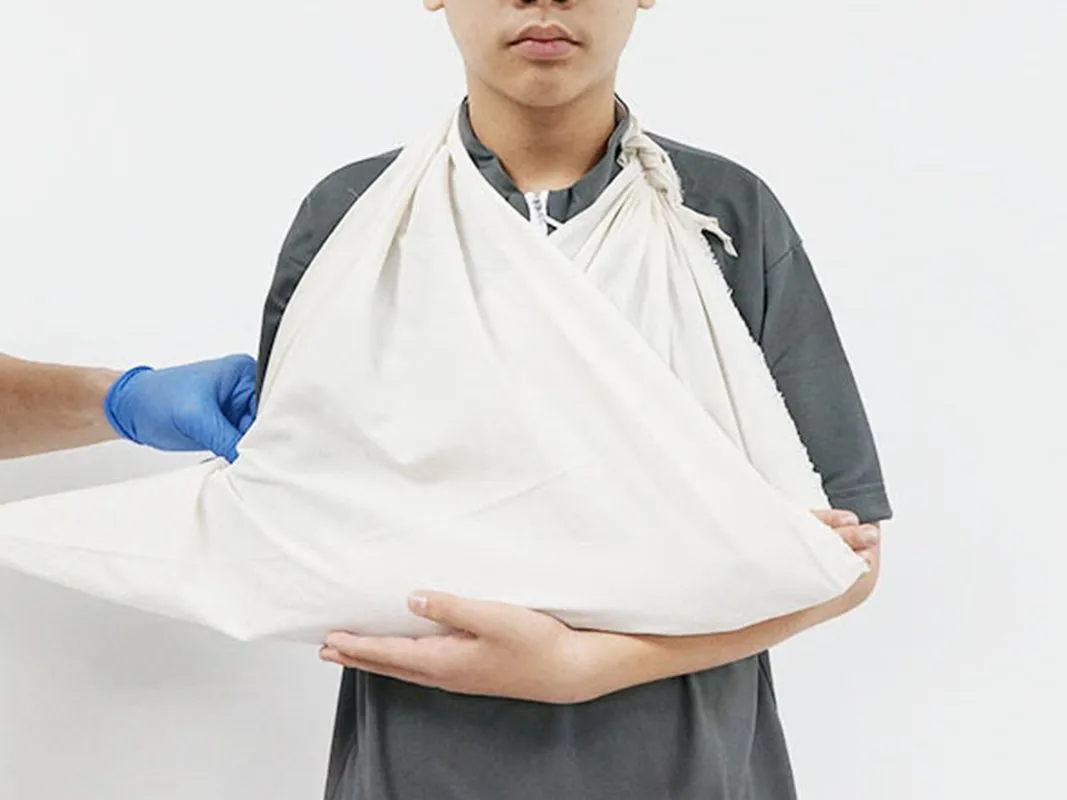
- Musculoskeletal injuries. Fracture immobilisation and bandaging.
- Burn injuries.
- Other first aid knowledge. Including EpiPen administration.
- CPR (Hands-Only) + AED.
Because chapter 8 is built in, SRFAC’s public information guidance asks centres to title the course “Standard First Aid” rather than “SFA + AED”, because CPR and AED are an integral part of the course, not an add-on. You still receive two separate certificates on completion.
Key takeaway: The syllabus is identical at every SRFAC-accredited centre in Singapore. What differs between providers is schedule, class size, venue and delivery format, not content.
3
How the 16 hours are actually structured
Quick Answer: SRFAC sets the Standard First Aid course at 16 hours total: 12 hours of content, 3.5 hours of practical assessment and 0.5 hours of theory assessment. The refresher course runs 12 hours, with the same assessment load and four fewer content hours.
Providers advertise “2 days” or “1 day blended”, but the underlying hours are fixed by SRFAC. Here is where they go:
| Component | Full course | Refresher |
|---|---|---|
| Teaching content (8 chapters) | 12.0 hrs | 8.0 hrs |
| Practical assessment | 3.5 hrs | 3.5 hrs |
| Theory assessment | 0.5 hrs | 0.5 hrs |
| Total course duration | 16.0 hrs | 12.0 hrs |
Source: Singapore Resuscitation and First Aid Council, 2020 Standard First Aid Syllabus Outline, effective 1 June 2020.
Note what does not shrink: assessment. The refresher cuts teaching time by a third but keeps the full four hours of testing. Skills fade faster than knowledge, and SRFAC’s structure reflects that.
Key takeaway: A quarter of the full course is assessment, not teaching. Plan for two full days, and expect to be physically tested rather than lectured at.
4
What the course costs after SkillsFuture funding
Quick Answer: The Standard First Aid course fee at Medlink is $196.20 including GST. Singapore Citizens and PRs aged 21 and above receive up to 50% SWDA funding, bringing it to $106.20. Singapore Citizens aged 40 and above, and SME-sponsored learners, receive up to 70%, bringing it to $70.20. See how SkillsFuture funding is applied.
SWDA sets baseline course fee funding at up to 50% for certifiable courses approved by SWDA, with enhanced schemes adding up to 20 percentage points on top. Both enhanced tiers, the Mid-Career Enhanced Subsidy and Enhanced Training Support for SMEs, land at 70%.
| Learner profile | Net fee payable | Subsidy |
|---|---|---|
| Singapore Citizen aged 40+ | $70.20 | 70% |
| SME-sponsored SC or PR | $70.20 | 70% |
| SC or PR aged 21+, self-sponsored | $106.20 | 50% |
| Non-SME sponsored, aged 39 and below | $106.20 | 50% |
| Not eligible for SWDA funding | $196.20 | None |
Course fee inclusive of GST. Funding tiers per SWDA Course Fee Funding and the Mid-Career Enhanced Subsidy. Grant amounts are estimates based on the prevailing SWDA calculator and are subject to change.
Three conditions apply to every funded place: the learner must have a SingPass account with a working device camera for digital attendance, achieve 100% attendance, and pass all assessments. Miss any one and the grant can be clawed back.
Sending a team rather than an individual?
Offsite training runs at your premises with a minimum of eight trainees. Request corporate course dates and rates →
5
How long the certificate lasts and when to renew
Quick Answer: A Standard First Aid certificate is valid for two years from the date you complete the course. SRFAC allows recertification in a window of three months before or three months after expiry. Miss that window by more than three months and you must restart the full 16-hour course, not the 12-hour refresher.
The three-month rule catches more people than any other part of the process. Here is the full certification lifecycle, straight from SRFAC’s training centre guidelines:
| Stage | SRFAC requirement |
|---|---|
| Theory assessment | 80% pass mark required |
| Attempts allowed | Maximum of three, theory and practical |
| Attendance | 100% required to be eligible for assessment |
| Certificate issued | Within 30 days of course completion |
| Validity | 2 years from date of course completion |
| Renewal window | 3 months before or 3 months after expiry |
| Lapsed over 3 months | Restart the full course; refresher no longer permitted |
Source: Singapore Resuscitation and First Aid Council, 2022 SRFAC SFA/CFA Training Centre Guidelines.
One more thing worth knowing before you book overseas: SRFAC states it “does not have any provisions for the recognition of foreign First Aid Provider or Instructor certificates.” A first aid certificate earned outside Singapore will not satisfy an NROC renewal or a workplace appointment here.
Key takeaway: Diarise your recertification for three months before expiry, not after. Letting it lapse past the window costs you four extra hours and the higher full-course fee.
Certification
Upon successfully completing the Standard First Aid course, learners are awarded these two first aid certificates to recognise their competencies.
1
CPR (Hands-Only) + AED Provider Certificate
Recognises competency in Hands-Only CPR and the operation of an Automated External Defibrillator, covered in chapter 8 of the syllabus.
2
Standard First Aid Provider Certificate
Recognises competency across the full SRFAC first aid syllabus, from unconscious casualties and bleeding through to burns and musculoskeletal injuries.
Both certificates are valid for two years. They are issued in credit-card format and released within 30 days of course completion. See how long the certificate lasts and when to renew above for the recertification window.
6
Renewing: the Standard First Aid Refresher
Quick Answer: If your Standard First Aid certificate has not been expired for more than three months, you renew with the 12-hour Standard First Aid Refresher rather than sitting the full 16-hour course again. The refresher is $185.30 including GST ($170 before GST), runs in-person or blended, and carries the same two-year certificate. SkillsFuture funding brings it down to $100.30, or $66.30 for Singapore Citizens aged 40 and above and SME-sponsored staff.
The refresher exists so that people who already hold the certificate do not repeat the whole syllabus. Entry is conditional: you need a valid certificate, or one that expired no more than three months ago. Book it three months before your expiry date and you never have to think about the deadline.
Standard First Aid Refresher Course
Click a card to flip and view key details
| Learner profile | Net fee payable | Grant |
|---|---|---|
| Singapore Citizen aged 40+ | $66.30 | $119 |
| SME-sponsored employee | $66.30 | $119 |
| Singapore Citizen or PR aged 21+ | $100.30 | $85 |
| Not eligible for SWDA funding | $185.30 | None |
Course fee inclusive of GST. Grant amounts are estimates based on the prevailing SWDA calculator and are subject to change.
Key takeaway: The refresher is only open while your certificate is valid or under three months expired. Past that window the full 16-hour course is the only route back.
7
How many first-aiders does your workplace need?
Quick Answer: Singapore’s Workplace Safety and Health (First-Aid) Regulations require one appointed first-aider for every 100 persons employed, in any workplace employing more than 25 people. The ratio must be met on every shift. Above 500 workers, a first-aid room is also required. For higher-risk sites, see Occupational First Aid.
The regulation reads: “Where more than 25 persons are employed in a workplace, there shall be appointed in the workplace as first-aiders who shall be readily available during working hours such number of persons as complies with the ratio of one first-aider for every 100 persons employed in the workplace or part thereof.”
“Or part thereof” does the heavy lifting. 101 employees needs two first-aiders, not one.
| Persons employed | First-aiders required | Additional obligation |
|---|---|---|
| 25 or fewer | Not required | None |
| 26 – 100 | 1 | Notice naming first-aiders posted |
| 101 – 200 | 2 | Treatment records maintained |
| 201 – 300 | 3 | None |
| 301 – 400 | 4 | None |
| 401 – 500 | 5 | None |
| More than 500 | 6+ | First-aid room required |
Source: Workplace Safety and Health (First-Aid) Regulations, regulations 5 and 6. Ratio applies separately to each shift. Penalty for non-compliance: fine up to $20,000 and/or imprisonment up to 2 years.
Two details employers regularly miss. First, the ratio applies per shift. A 24-hour operation with 90 staff across three shifts still needs a trained first-aider present on each one. Second, the Regulations do not apply to hospitals or medical clinics, which sit under separate requirements.
Key takeaway: Count by shift, not by headcount. Most under-provisioned workplaces got the total right and the shift coverage wrong.
8
In-person or blended: which format to book
Quick Answer: The in-person format runs two days at 30 Sam Leong Road. The blended format moves six hours of theory to self-paced e-learning, leaving ten hours in the classroom across one day. Both carry the same fee, the same SRFAC assessment and the same certificate. Check available dates for both formats.
SRFAC permits e-learning for the theory component, but is specific that “hands-on practice, practical and theory assessment must be conducted in the presence of the instructor.” Blended reduces classroom days; it does not reduce supervised assessment.
Choose in-person if you prefer instructor-led teaching throughout, or if you would rather not manage e-learning around work.
Choose blended if you can only spare one working day. The e-learning opens a week before your classroom date and must be finished beforehand.
Language. Courses run in English. Mandarin is available with a minimum of four trainees.
Offsite delivery. Available at your premises with a minimum of eight trainees. An offsite fee applies.
One health note that applies to both formats: the practical assessment requires two minutes of continuous chest compressions, which is physically demanding. Anyone with back, knee, spinal or cardiac conditions should speak to a doctor first, and trainees who are or may be pregnant are advised to enrol after maternity leave.
More From Medlink
Popular first aid courses
Explore other SRFAC and SWDA-accredited courses run by our team, from infant care to workplace certification.
Standard First Aid
+ AED
$196.20 incl. GST ($180 before GST)
See Details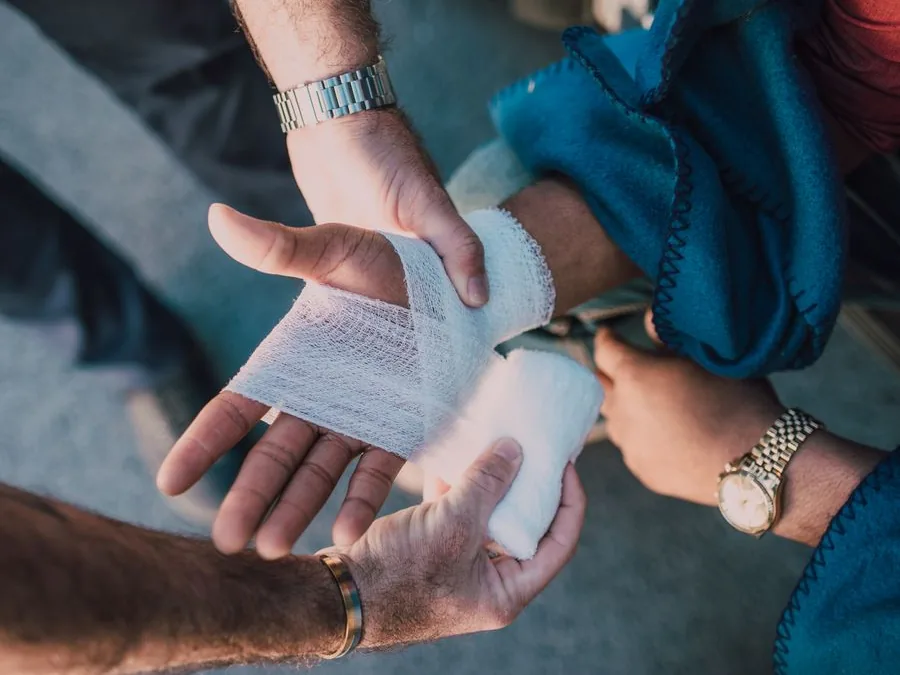
Basic First Aid
+ AED
$141.70 incl. GST ($130 before GST)
See Details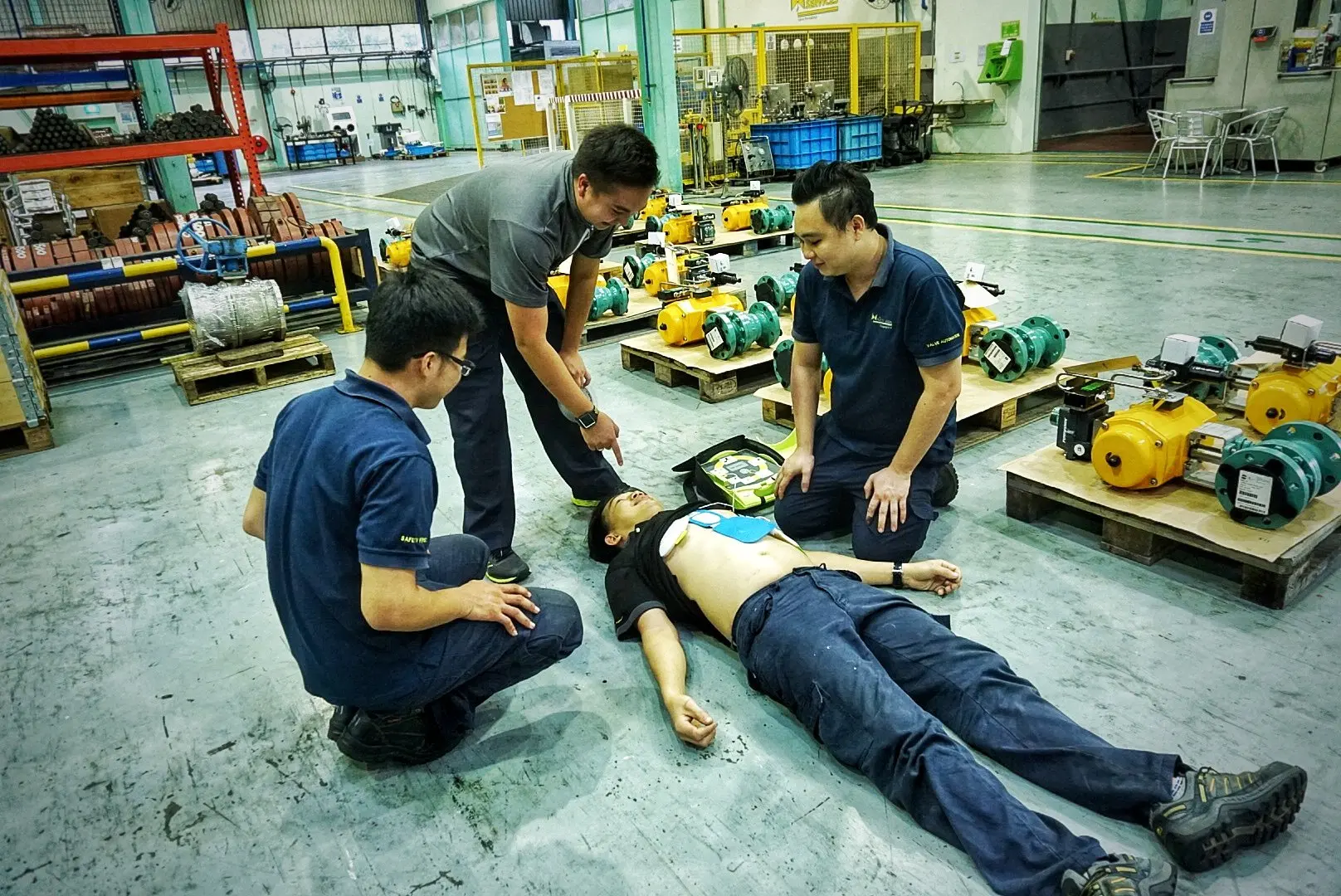
Occupational First Aid
+ AED
$346.62 incl. GST ($318 before GST)
See Details
9
Frequently asked questions
No, though it includes them. CPR (Hands-Only) + AED is chapter 8 of the eight-chapter Standard First Aid syllabus, and you receive a separate certificate for it. If you only need the cardiac component, the shorter CPR + AED course covers that alone.
Two years from the date you complete the course, per SRFAC. Recertification is permitted from three months before expiry to three months after. Beyond that window, you must retake the full 16-hour course.
Standard First Aid is the general workplace and coaching certification. Occupational First Aid is the 23.5-hour course for designated occupational first aiders in higher-risk environments such as construction and marine. If your safety officer has specified OFA, Standard First Aid will not substitute.
Singapore Citizens can apply SkillsFuture Credit toward the balance payable after the SWDA grant. Note that the $500 one-off top-up issued in 2020 expired on 31 December 2025 and can no longer be used. The Opening Credit of $500, granted at age 25, does not expire.
SRFAC allows a maximum of three attempts at both the theory and practical assessments. Attending the course but opting out of the CPR + AED assessment results in a Certificate of Attendance only, not the provider certification.
Yes. Medlink Healthcare Group is listed as an SRFAC-accredited Standard First Aid training centre. Accreditation status for all Singapore training centres is published in the SRFAC training centre directory.
Ready to book your Standard First Aid course?
Tell us your preferred format and dates, and our team will confirm availability and your funded fee, usually within one working day.