
Child First Aid
Child First Aid Course Singapore (CFA) | ECDA
Last updated: 20 August 2026
20 hours · SRFAC syllabus
Recognised by ECDA
TL;DR: The child first aid course Singapore preschools rely on is CFA, one of four basic courses accredited by SRFAC. It runs 20 hours and issues three separate Provider certificates — CFA, BCLS+AED and Standard First Aid, each valid for two years.
Child First Aid Course
Click a card to flip and view key details
Most people book this course because a licence depends on it. A centre manager reads a clause in the Code of Practice, counts the certificates on file, and finds the number short.
That is a fair reason to book. But CFA is not Standard First Aid with a smaller manikin. It is a longer course on a different syllabus, ending with three certificates instead of one. This page sets out what the child first aid course Singapore training centres run actually contains, how long it takes, how it is assessed, and what ECDA asks of the staff who hold it. Every figure comes from SRFAC, ECDA or Singapore Statutes Online.
1
What is the Child First Aid course in Singapore?
Quick Answer: Child First Aid, abbreviated CFA, is one of four basic courses accredited by the Singapore Resuscitation and First Aid Council, alongside BCLS+AED, CPR(Hands-Only)+AED and Standard First Aid. It teaches first aid for infants and children as well as adults.
CFA is not a standalone syllabus. SRFAC states that child first aid topics are embedded into the Standard First Aid syllabus and enhanced with BCLS+AED content to form the Child First Aid course. You are not choosing between CFA and Standard First Aid. CFA contains it.
- Adult content stays. Airway obstruction, bandaging, fractures, burns and poisoning are taught in full.
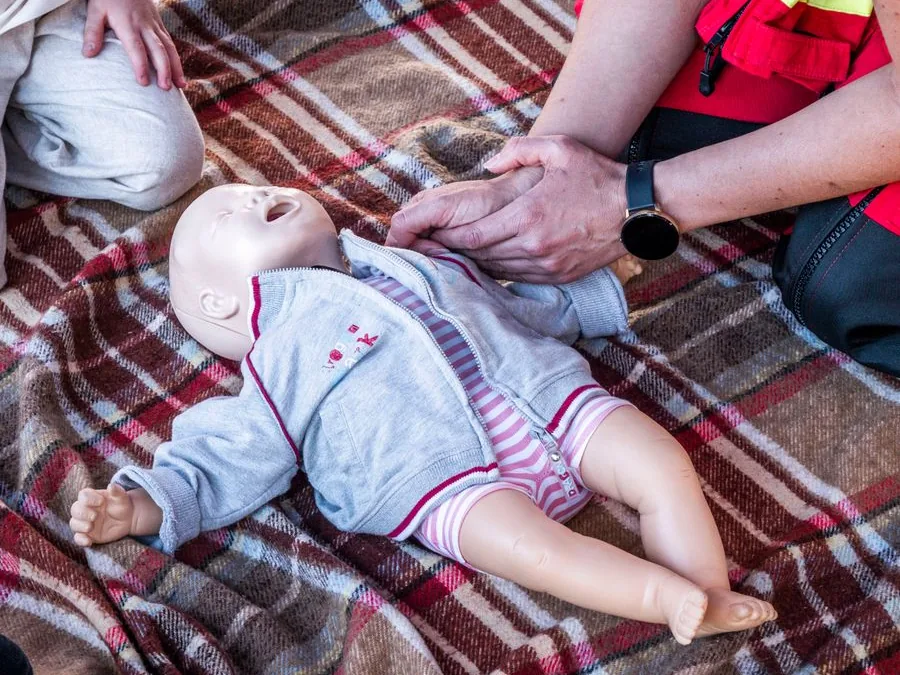
- Paediatric content is added. Infant airway obstruction, infant CPR, the lateral position for infants, and child-versus-adult anatomy.
- Cardiac content is deepened. The CPR component runs to BCLS+AED depth, not the shorter hands-only version inside Standard First Aid.
A training centre cannot run CFA on its own either. Since 1 August 2019, SRFAC has required a Child First Aid Training Centre to already be an accredited BCLS+AED Provider Training Centre and an accredited Standard First Aid Provider Training Centre.
Key takeaway: CFA is the widest of SRFAC’s four basic courses, not a narrow paediatric add-on. If you hold CFA, you already hold Standard First Aid and BCLS+AED.
Not sure which course your centre actually needs?
The requirement usually sits in a licence condition or a staffing table rather than a brochure. Compare the Standard First Aid course →
2
Who must hold CFA under ECDA's Code of Practice?
Quick Answer: ECDA’s Early Childhood Development Centres Code of Practice requires the Key Personnel or Principal to hold CFA certification, and sets a minimum number of CFA-certified staff who must be present depending on the centre’s licence class and headcount.
The requirement is a presence rule, not a tally of who has ever attended. Certificates in a file do not satisfy it if the holders are not rostered on.
Licence classes map to age groups. Under the Early Childhood Development Centres Regulations 2018, an infant class runs for children 2 months of age or older but below 18 months. Class A covers those infants; Class B and C cover 18 months to below 7 years.
| Licence held | Minimum CFA-certified staff present | Additional staff trigger |
|---|---|---|
| Every centre | Key Personnel or Principal must hold CFA | Not applicable |
| Class A only (infants) | 3 programme staff during operating hours, one being Key Personnel or Principal | 1 more per 50 infants, or part thereof, above 50 |
| Class A with Class B or C | 1 Infant Educator or Programme Helper for the Class A area | 1 more per 50 infants, or part thereof, above 50 |
| Class B or C, programme hours | 3 staff | 1 more per additional 50 children above 150 per session |
| Class B or C, non-programme hours | 1 staff | Not specified |
Source: ECDA, Early Childhood Development Centres Code of Practice, Fourth Edition (2025), section 4.4.
Two details catch centres out. A Class B or C centre still needs one CFA-certified person on site outside programme hours. And the triggers count part thereof, so 51 infants already means an extra certified person.
The Code also names a scenario CFA prepares for directly. Where a child has high-risk food allergies, ECDA requires the centre to hold a copy of the Action Plan for Anaphylaxis signed by a medical practitioner. A plan is only as good as the staff who can act on it, which is why adrenaline auto-injector administration is assessed.
Key takeaway: Count CFA holders against your roster, not your staff list. The Code asks who is present, and it asks the same question outside programme hours.
3
What the CFA syllabus covers, chapter by chapter
Quick Answer: SRFAC’s Child First Aid syllabus sets 15 hours of minimum content across eight chapters. CPR and AED is the largest at 225 minutes, and respiratory problems the second largest at 150 minutes — the two chapters most tied to cardiac life support skills.
The chapter weighting tells you what the course is really about, and it is not grazed knees.
| CPR and AED | 225 | |
| Respiratory problems | 150 | |
| Shock, bleeding and wounds | 120 | |
| Musculoskeletal injuries | 120 | |
| Unconscious casualty | 90 | |
| Other first aid knowledge | 90 | |
| Essentials of first aid | 75 | |
| Burn injuries | 30 |
Source: SRFAC, Syllabus Outline for Child First Aid, 2020. Theory and practical minutes combined.
The paediatric material inside those chapters is specific. The syllabus names the techniques a childcare worker is most likely to need first.
- Infant airway obstruction. A conscious infant receives 5 back blows and 5 chest thrusts, not the Heimlich manoeuvre.
- Infant CPR. Taught and practised separately from adult CPR.
- Lateral position for infants. The infant recovery position, used to increase airway volume and reduce stridor severity.
- Asthma and anaphylaxis. Metered dose inhaler with spacer and facemask, plus adrenaline auto-injector administration.
- Child and adult differences. A dedicated topic on paediatric anatomy and on handling both the casualty and the parents.
Key takeaway: CPR and AED plus respiratory problems account for 375 of the 900 minimum content minutes. Choking and cardiac arrest are the spine of this course.
4
How long is the Child First Aid course?
Quick Answer: The full CFA course runs 20 hours, and the refresher runs 16 hours. The difference sits almost entirely in theory time. Practical hours are identical, which is why the Child First Aid refresher course is shorter but not lighter.
Most centres plan CFA across two or three days. For rostering, what matters is the split between theory you can compress and practical you cannot.
| Component | Full course | Refresher |
|---|---|---|
| Theory content | 7 hours | 3 hours |
| Practical content | 8 hours | 8 hours |
| Content subtotal | 15 hours | 11 hours |
| Practical assessment | 4 hours | 4 hours |
| Theory assessment | 1 hour | 1 hour |
| Total course duration | 20 hours | 16 hours |
Source: SRFAC, Syllabus Outline for Child First Aid, 2020.
Part of the theory can move online, but only part. SRFAC permits e-learning packages and states that learners may complete the theory lesson online, while the remaining hands-on practice, practical assessment and theory assessment must be conducted in the presence of the instructor.
Key takeaway: The 4-hour saving between full course and refresher comes out of theory. Practical hours and assessment hours are unchanged, so plan the same floor time either way.
5
How is the Child First Aid course assessed?
Quick Answer: CFA is assessed by a theory paper of at least 50 questions passed at 80 per cent, plus a five-part practical test with a maximum of three attempts. Both must be passed, the same rule that governs the Standard First Aid course.
The theory paper reflects the course’s three strands, with a minimum question count for each. The practical test covers five skills.
| Assessment element | SRFAC minimum standard |
|---|---|
| Theory paper | |
| Standard First Aid questions | At least 20 |
| BCLS+AED questions | At least 20 |
| Child First Aid questions | At least 10 |
| Pass mark | 80 per cent correct answers |
| Practical test | |
| Cardiac component | BCLS+AED |
| Bandaging | 1 bleeding wound and 1 fracture |
| Tourniquet | Application assessed |
| Medication devices | Adrenaline auto-injector, and MDI with spacer and facemask |
| Attempts permitted | Maximum of three |
Source: SRFAC, Guidelines for Standard and Child First Aid Training Centres, 2022.
The facemask detail is easy to skim past. A CFA Training Centre must hold infant manikins and an additional facemask to attach to the spacer, because a small child cannot use a spacer mouthpiece the way an adult can. Equipment, not just curriculum, separates a CFA centre from a Standard First Aid one.
SRFAC is also explicit that both halves must be cleared: learners who do not pass both theory and practical assessment should not be issued a Provider certificate.
Key takeaway: The theory paper is weighted towards adult first aid and cardiac care, with only 10 of the 50 minimum questions on paediatric content. Prepare for all three strands.
6
Three certificates from one course, and how renewal works
Quick Answer: Completing CFA issues three Provider certificates — Child First Aid, BCLS+AED and Standard First Aid. Each runs two years, and renews through the Child First Aid refresher course taken within a three-month window either side of expiry.
The three-certificate outcome is the detail most often missed at budgeting time. Staff sent on CFA do not need to be sent on Standard First Aid or BCLS+AED separately.
Renewal is where certificates are actually lost. The window is tight, and missing it costs a repeat of the full 20-hour course.
- Validity is two years. The Provider certificate runs two years from the date of course completion.
- The window is six months wide. Attend a re-certification course 3 months before or after the expiry date.
- Lapse past three months and you restart. Lapsed more than 3 months from expiry and the learner restarts under the entry criteria.
- The certificate is issued within 30 days. Validity starts from course completion, and a memo is issued if it is not immediately available.
- Foreign certificates do not transfer. SRFAC has no provisions for recognising foreign First Aid Provider or Instructor certificates.
Check the wording on the certificate too. SRFAC requires it to carry the course type, a validity period, a serial or course reference number, and the line “Accredited by the Singapore Resuscitation and First Aid Council”. If a certificate in a licence file lacks it, query it before an audit does.
Key takeaway: Diarise expiry dates 3 months early. Missing the window costs 20 hours of staff time rather than a rebooking fee.
Certificates coming up for renewal this year?
The refresher is 16 hours and only available inside the three-month window either side of expiry. See the Child First Aid refresher course →
7
Renewing: the Child First Aid Refresher
Quick Answer: If your Child First Aid certificate has not been expired for more than three months, you renew with the 2-day Child First Aid Refresher rather than sitting the full course again. It is $224.54 including GST ($206 before GST), runs 16 hours in person, and renews all three certificates. SkillsFuture funding brings it down to $121.54, or $80.34 for Singapore Citizens aged 40 and above.
One 2-day refresher renews all three certificates the full course awards — Child First Aid Provider, Standard First Aid Provider, and BCLS + AED Provider — which is the alternative to three separate bookings. Entry is a certificate that is still valid or expired by no more than three months, and Medlink recommends booking three months before the expiry date. The refresher runs in person only: mhg.sg shows a blended option on this page, but the link goes to the full Child First Aid course, not to a blended refresher.
Child First Aid Refresher Course
Click a card to flip and view key details
| Learner profile | Net fee payable | Grant |
|---|---|---|
| Singapore Citizen aged 40+ | $80.34 | $144.20 |
| Singapore Citizen or PR aged 21+ | $121.54 | $103 |
| Not eligible for SWDA funding | $224.54 | None |
Course fee inclusive of GST. Grant amounts are estimates based on the prevailing SWDA calculator and are subject to change. Source: Medlink Healthcare Group refresher course page, read 24 September 2026.
Key takeaway: Three certificates expire on the same day, and one 2-day refresher renews all three — but only within three months of that date.
8
CFA compared with Standard First Aid and BCLS+AED
Quick Answer: CFA is the longest of the three and the only one covering infants. Standard First Aid covers adult first aid with hands-only CPR; BCLS+AED covers cardiac emergencies only. CFA contains the content of both.
The setting usually settles it. A workplace with no children on site has no reason to sit a 20-hour paediatric course, and a preschool cannot substitute a cardiac-only course for a licence requirement.
- Choose CFA when children are in your care. Preschools, infant care and enrichment centres, where ECDA’s Code of Practice applies.
- Choose Standard First Aid for general workplaces. Adult bleeding, fractures, burns and hands-only CPR, without the infant module.
- Choose BCLS+AED when the requirement is cardiac only. Clinical roles where a BCLS+AED Provider certificate is named specifically.
Because CFA already issues a Standard First Aid Provider certificate, staff holding CFA do not separately need the Standard First Aid refresher course; their SFA certificate renews through the CFA refresher. Splitting staff across both tracks creates duplicate expiry dates for no benefit.
Key takeaway: Let the setting decide, not the price list. CFA is the only one of the three that covers infants, and it absorbs the other two.
9
What to check before booking a child first aid course
Quick Answer: Check that the provider holds current CFA Training Centre accreditation, that the course title matches SRFAC’s official wording, that infant manikins are used, and that any quote is GST-inclusive before you commit a group booking.
Accreditation is verifiable rather than a matter of trust. SRFAC publishes a public training-centre directory listing each centre’s certifications and licence expiry dates.
- The course title on the certificate. SRFAC’s official title is Child First Aid, abbreviated CFA. Certificates should carry it exactly.
- Instructor and equipment ratios. From 1 January 2023 there is no class size limit, but a ratio of 1 instructor to 8 learners applies to non-manikin practicals, and 1 instructor to 1 manikin to 4 learners for CPR, unconscious choking and AED.
- Infant manikins on the floor. Adult manikins alone cannot deliver the infant CPR component.
- How much is e-learning. Theory may be online; hands-on practice and both assessments must happen with the instructor present.
- Whether the quote includes GST. Medlink quotes are GST-inclusive, so the figure you see is the figure you pay.
One scheduling note. SRFAC recommends that course materials reach learners at least two weeks before the course. If you are booking to beat a certificate expiry, work backwards from that lead time.
Key takeaway: Confirm CFA accreditation, infant manikins and the GST position in writing. All three are checkable before a deposit changes hands.
Need CFA-certified staff on the roster by a fixed date?
Send us your licence class, infant headcount and the expiry dates you are working to. Ask the Medlink training team about CFA dates →
10
Inside Medlink’s Child First Aid course
Quick Answer: Medlink runs Child First Aid over 20 hours at 30 Sam Leong Road, across the same eight-chapter first aid syllabus taught for adults, re-pitched at infants and children. The theory paper is 50 questions covering four syllabuses, and the practical runs nine stations. Three certificates come out of it.
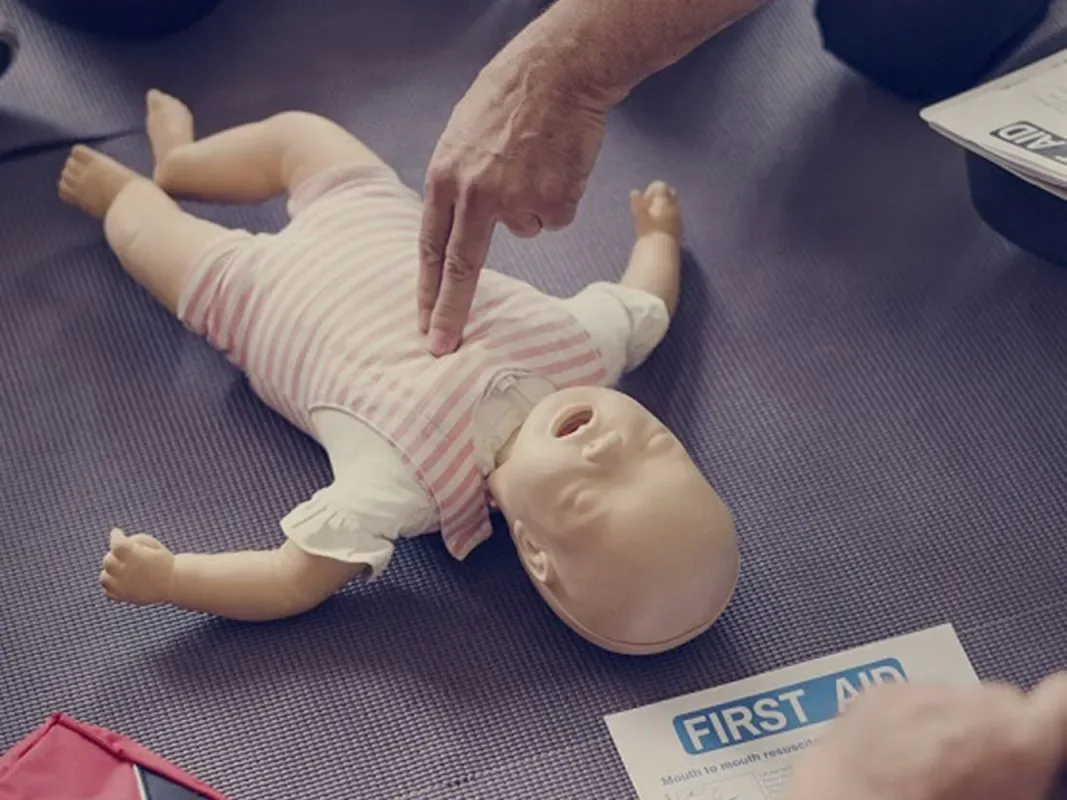
Medlink publishes the Child First Aid course content as eight chapters:
- Essentials of first aid.
- Unconscious casualty (non-cardiac arrest).
- Respiratory problems.
- Shock, bleeding and wounds.
- Musculoskeletal injuries.
- Burn injuries.
- Other first aid knowledge.
- CPR + AED.
Entry requirements and health notes. Trainees need enough English to follow the course and should be physically fit, since part of the assessment calls for two minutes of continuous chest compressions and ventilations. Anyone with back, knee, spinal, joint, heart or lung conditions should consult a doctor first, and trainees who are or may be pregnant are advised to enrol after maternity leave.
| Component | Requirement |
|---|---|
| Theory paper | 50 multiple-choice questions in one hour, three attempts allowed |
| — Child First Aid | 10 questions, 70% to pass |
| — Standard First Aid | 20 questions, 70% to pass |
| — Basic Cardiac Life Support | 20 questions, 70% to pass |
| — CPR (Hands-Only) + AED | 10 questions, 80% to pass |
| Practical — resuscitation | Adult and infant CPR + AED, including MTM and BVM |
| Practical — choking | Adult and infant airway obstruction, conscious and unconscious |
| Practical — injury | Bandaging (one bleeding, one fracture) and tourniquet application |
| Practical — medication | EpiPen administration and MDI with spacer |
| Attendance | 100% required to be eligible for assessment |
Source: Medlink Healthcare Group, Child First Aid course page, read 23 September 2026.
Certification
What the course awards on successful completion.
1
Child First Aid Provider
The certificate ECDA’s framework asks childcare and preschool staff to hold.
2
Standard First Aid Provider
The general workplace and coaching first aid certificate, issued from the same course.
3
BCLS + AED Provider
The resuscitation certificate that advanced life support courses ask for as a prerequisite.
All three certificates are valid for two years and expire together. Results are released on the day of training or within two working days, and the credit-card certificates follow.
Key takeaway: One 20-hour course, four syllabuses examined and three certificates issued — which is why CFA is the efficient choice for a centre that also needs adult cover.
11
Booking Child First Aid training with Medlink
Quick Answer: Medlink delivers SRFAC-accredited first aid training alongside industrial paramedicine and HCSA-licensed ambulance services. Tell the team your licence class, headcount and certificate expiry dates, and the course scheduling follows from those three facts.
Medlink is a Singapore healthcare group whose work spans first aid training, industrial paramedicine, and licensed emergency transport. The people who teach the CPR component also work the vehicles that arrive when someone calls 995.
For a group booking, three details move things fastest.
- Licence class and headcount. Class A, B or C, and the number of children per session, which sets how many CFA holders the Code expects on site.
- First certification or renewal. First certification is the 20-hour course; a renewal inside the window is the 16-hour refresher.
- Expiry dates. These set the deadline, and they are why most bookings are time-critical.
Reach the training team through the Medlink contact page, or browse the full course range on the Medlink Healthcare Group site.
Key takeaway: Lead with licence class, headcount and expiry dates. Those three facts decide the course, the group size and the deadline.
12
Conclusion: matching the course to the requirement
Quick Answer: The child first aid course Singapore preschools need is CFA — 20 hours, three certificates, two years of validity. Renewal runs through the 16-hour Child First Aid refresher inside a three-month window either side of expiry.
Read as compliance, CFA is a box to tick. Read as training, it is 20 hours spent mostly on choking, cardiac arrest and bleeding: the three things that turn a normal afternoon in a childcare centre into an emergency.
The certificates matter because ECDA counts them. The skills matter because a two-year-old cannot wait for the ambulance before someone starts back blows.
13
Frequently asked questions
The full CFA course runs 20 hours: 15 hours of minimum content plus 5 hours of assessment, per SRFAC’s Child First Aid syllabus outline. The refresher runs 16 hours, with the saving taken entirely out of theory time.
Three. SRFAC’s syllabus states that on completion the learner is issued a Child First Aid Provider certificate, a BCLS+AED Provider certificate and a Standard First Aid Provider certificate. Staff holding CFA do not need to sit the other two separately.
Yes. ECDA’s Early Childhood Development Centres Code of Practice requires the Key Personnel or Principal to hold CFA certification, and sets minimum numbers of CFA-certified staff who must be present during operating or programme hours depending on the centre’s licence class and headcount.
Two years from the date of completion of the Provider course. Renewal requires attending a re-certification course three months before or after the printed expiry date. Lapse more than three months past expiry and SRFAC requires the learner to restart under the entry criteria.
Only partly. SRFAC permits e-learning packages where the theory lesson is completed online, but the remaining hands-on practice, the practical assessment and the theory assessment must be conducted in the presence of the instructor. A fully online course would not meet SRFAC’s accreditation standard.
Ready to arrange Child First Aid training for your centre?
Tell us your licence class, how many staff need certifying, and the expiry dates you are working to. We will confirm the right course, the available dates and a GST-inclusive quote.
More From Medlink
Popular first aid courses
Explore other SRFAC and SWDA-accredited courses run by our team, from infant care to workplace certification.
Standard First Aid
+ AED
$196.20 incl. GST ($180 before GST)
See Details
Basic First Aid
+ AED
$141.70 incl. GST ($130 before GST)
See Details
Occupational First Aid
+ AED
$346.62 incl. GST ($318 before GST)
See Details