
Basic Cardiac Life Support
Basic Cardiac Life Support Course Singapore (BCLS)
Last updated: 20 August 2026
8 hours · SRFAC syllabus
SkillsFuture funding available
TL;DR: The basic cardiac life support course Singapore employers ask for is BCLS+AED — an SRFAC-accredited basic course covering adult and infant CPR, ventilations, choking relief and defibrillation. The Provider certificate is valid for two years. You must pass both a theory paper and a practical test to hold it.
Basic Cardiac Life Support Course
Click a card to flip and view key details
A BCLS+AED certificate does two jobs. It teaches you to keep a collapsed adult or infant alive until an ambulance arrives, and it is the entry requirement for every SRFAC advanced life support course. Miss the renewal window and both doors close.
This page covers the syllabus, the assessment, the certificate’s lifespan, and who needs BCLS+AED rather than a shorter or broader first aid course. Every requirement below comes from the Singapore Resuscitation and First Aid Council (SRFAC), which accredits the course.
1
What is the Basic Cardiac Life Support course in Singapore?
Quick Answer: The basic cardiac life support course Singapore recognises is officially titled Basic Cardiac Life Support with Automated External Defibrillator, abbreviated BCLS+AED. SRFAC lists it as one of four accredited Basic courses, alongside CPR(Hands-Only)+AED, Standard First Aid and Child First Aid.
The name matters because certificates are checked against it. SRFAC publishes the official course titles for every accredited course, and requires certificates to carry the exact title plus the words “Accredited by Singapore Resuscitation and First Aid Council”.
The four Basic courses differ in scope:
- BCLS+AED. Adult and infant CPR with ventilations, choking relief and defibrillation.
- CPR(Hands-Only)+AED. Compression-only adult CPR and AED use. No ventilations, no infant component.
- Standard First Aid. Injury and illness management, with hands-only CPR and AED built in.
- Child First Aid. First aid pitched at infants and children, commonly required in preschools.
If a form says “BCLS”, it means BCLS+AED. The older mouth-to-mouth CPR course is not an alternative: SRFAC withdrew CPR(Mouth-To-Mouth)+AED from 1 May 2020 and now points learners who need ventilation skills to BCLS+AED instead.
Key takeaway: BCLS+AED is the full title, and the only SRFAC basic course teaching ventilations and infant resuscitation together.
Not sure which first aid course your role needs?
The pillar guide sets out how the SRFAC course family fits together. Compare the SRFAC first aid courses →
2
Who needs BCLS+AED — and who needs a different course
Quick Answer: BCLS+AED is the right course when a resuscitation certificate is the requirement itself, or a stated prerequisite for advanced training. It is the wrong course when you actually need a workplace first aider or coaching registry certificate.
Most people arrive at the basic cardiac life support course Singapore offers because a form told them to. Read that form closely — three different requirements get confused with each other.
- Resuscitation and advanced-course entry. Clinical staff, and anyone enrolling in an SRFAC advanced course, need a current BCLS+AED Provider certificate. This is the group the course is designed for.
- Workplace first aiders. The Workplace Safety and Health (First-Aid) Regulations require employers to appoint trained first aiders in a ratio to the number of persons employed. A first aid certificate meets that obligation; a resuscitation-only one does not.
- Sports coaches. Coaches registering with Sport Singapore’s National Registry of Coaches must hold a valid Standard First Aid certificate. NROC membership runs three years, and a lapsed certificate is one of the stated reasons a coach’s status turns inactive.
If you fall into the second or third group, the Standard First Aid course is what the requirement is asking for, and the Standard First Aid refresher keeps it alive. Booking BCLS+AED instead is a common and expensive mix-up.
Key takeaway: BCLS+AED answers a resuscitation requirement; Standard First Aid answers a workplace or coaching-registry one.
3
BCLS+AED or CPR(Hands-Only)+AED: what the wider scope covers
Quick Answer: BCLS+AED covers everything CPR(Hands-Only)+AED covers, then adds rescue ventilations, infant CPR and choking relief for adults and infants. SRFAC sets a longer theory paper and practical test to match.
The two courses are often treated as interchangeable. SRFAC’s assessment requirements show they are not. The table below compares the two on the components each one must assess.
| Assessed component | BCLS+AED | CPR(Hands-Only)+AED |
|---|---|---|
| Adult CPR | With ventilations | Compressions only |
| Use of an AED | Assessed | Assessed |
| Infant CPR | Assessed | Not assessed |
| Adult choking, conscious and unconscious | Assessed | Not assessed |
| Infant choking, conscious and unconscious | Assessed | Not assessed |
| Theory paper, minimum questions | 20 | 10 |
Source: SRFAC, 2023 Reference Guide for BCLS+AED Training Centres, assessment requirements.
A hands-only certificate does not prepare you for an infant, or for a choking casualty who then collapses. If either scenario is realistic where you work, the wider BCLS+AED syllabus is the one to book.
Key takeaway: The gap is not technique polish. It is infant resuscitation, choking relief and ventilations — three scenarios the shorter course never tests.
4
How the training room is run
Quick Answer: SRFAC sets a default instructor-to-manikin-to-learner ratio of 1:1:4, relaxing to 1:2:6 for manikin-based hands-on work where equipment and instructor experience allow. Theory may be taken online; the hands-on work and both assessments may not.
Ratios are the quiet quality control on a resuscitation course. They decide how many minutes of compressions you perform rather than watch, so SRFAC caps them instead of leaving them to the training centre.
- Default ratio 1:1:4. One instructor, one manikin, four learners.
- Relaxed ratio 1:2:6. Permitted for manikin-related hands-on work such as CPR with AED and unconscious choking relief, only where there are enough manikins and the instructors are experienced and capable.
- Specified manikins. Practical assessment of one-rescuer CPR must use manikins that capture the information the assessment criteria require.
E-learning is allowed for one part of the course only. SRFAC lets learners on e-learning packages complete the theory lesson online or remotely, while the hands-on practice, the practical assessment and the theory assessment all happen in the instructor’s presence. A course advertised as fully online would not meet the standard.
Key takeaway: You can read the theory at home, but SRFAC requires both assessments to happen in front of an instructor.
5
How the BCLS+AED assessment works, and what happens if you do not pass
Quick Answer: There are two assessments. The theory paper carries a minimum of 20 questions with a pass mark of 80 per cent and up to three attempts. The practical test covers five scenario groups, also with up to three attempts. Both must be passed for a Provider certificate.
SRFAC’s reference guide sets out the two halves separately, and both carry equal weight.
| Requirement | Specification |
|---|---|
| Theory assessment | |
| Question papers available | At least 3 different sets, used interchangeably |
| Minimum questions per paper | 20 |
| Pass mark | 80% |
| Attempts allowed | Up to 3 |
| Practical assessment | |
| Scenario 1 | Adult CPR with mouth-to-mouth ventilations |
| Scenario 2 | AED use, across shock and no-shock scenarios |
| Scenario 3 | Adult choking, conscious and unconscious |
| Scenario 4 | Infant CPR |
| Scenario 5 | Infant choking, conscious and unconscious |
| Attempts allowed | Up to 3 |
Source: SRFAC, 2023 Reference Guide for BCLS+AED Training Centres, “Program and Content”.
The 80 per cent theory pass mark on a 20-question paper means four wrong answers is the limit. SRFAC is equally firm that partial success does not produce a partial certificate, and the three documents involved are easy to confuse:
- Provider certificate. Issued only when both assessments are passed. Carries the course title, validity period, serial or course reference number, and the SRFAC accreditation wording.
- Certificate of Attendance. May be issued where the theory lessons are completed and the theory test passed in front of training centre staff. Acceptance rests with the employing institution, and it does not stand in for a Provider certificate.
- Theory-only certificate. A separate route for learners exempted from the practical component on age or medical grounds, where the healthcare institution documents the exemption.
Where the Provider certificate is not ready on the day, the training centre should issue a memo confirming completion, with the certificate following within 30 days of the course.
Key takeaway: Four wrong answers is the theory limit. A Certificate of Attendance is not a Provider certificate, and only the latter proves BCLS+AED competence.
Certifying a whole team at once?
Group runs can be scheduled at your premises where space and manikin ratios allow. Ask about corporate BCLS+AED scheduling →
6
Certificate validity and the renewal clock
Quick Answer: A BCLS+AED Provider certificate is valid for two years from course completion. Re-certification is available up to three months after the stated expiry date. Lapse by more than three months and the full course must be retaken.
The renewal rules run on a fixed timeline, and reading it as a calendar makes the deadlines obvious.
| Point on the timeline | Certificate status | What you can book |
|---|---|---|
| Course completion day | Valid, 2-year clock starts | Nothing needed yet |
| Within 30 days of the course | Certificate must be issued | Chase the memo if it is late |
| Up to 3 months before expiry | Valid | Refresher course |
| Stated expiry date, month 24 | Expired | Refresher course |
| Up to 3 months after expiry | Expired, still renewable | Last chance for the refresher |
| More than 3 months after expiry | Lapsed | Full course, from the start |
Source: SRFAC, 2023 Reference Guide for BCLS+AED Training Centres; SRFAC Entry and Renewal Requirements for BCLS+AED Providers.
One nuance is worth knowing before booking a renewal. Renew inside the permitted window and the fresh two-year validity may run from the stated expiry date rather than the training date, so renewing early costs you nothing. If your certificate is still current, the BCLS+AED refresher course is the shorter route back.
Three months past expiry is the line. On one side is a refresher; on the other, the full course again.
Key takeaway: Diarise the expiry the week your certificate arrives. The three-month grace period is all that stands between a refresher and a full re-sit.
7
Renewing: the BCLS + AED Refresher
Quick Answer: If your BCLS + AED certificate has not been expired for more than three months, you renew with the half-day BCLS + AED Refresher rather than repeating the full course. It is $141.70 including GST ($130 before GST), runs 5 hours in person, and carries the same two-year certificate. SkillsFuture funding brings it down to $76.70, or $50.70 for Singapore Citizens aged 40 and above and SME-sponsored staff.
The refresher is half a day against a full day, and roughly a third cheaper than sitting the course again — which is the whole reason to book before the expiry date rather than after it. Entry is a certificate that is still valid, or one that expired no more than three months ago; Medlink recommends booking three months ahead so the certification never lapses. It renews the same two certificates the full course awards: CPR (Hands-Only) + AED Provider, and Basic Cardiac Life Support Provider (Refresher).
Basic Cardiac Life Support Refresher Course
Click a card to flip and view key details
| Learner profile | Net fee payable | Grant |
|---|---|---|
| Singapore Citizen aged 40+ | $50.70 | $91 |
| SME-sponsored employee | $50.70 | $91 |
| Singapore Citizen or PR aged 21+ | $76.70 | $65 |
| Not eligible for SWDA funding | $141.70 | None |
Course fee inclusive of GST. Grant amounts are estimates based on the prevailing SWDA calculator and are subject to change. Source: Medlink Healthcare Group refresher course page, read 24 September 2026.
Key takeaway: Three months past the expiry date the refresher closes and the full 8-hour course is the only route back. Diarise the expiry, not the booking.
8
Why BCLS+AED is the gateway to advanced life support courses
Quick Answer: Since 1 May 2023, SRFAC has required a valid BCLS+AED Provider certificate for enrolment in advanced provider courses, for enrolment in advanced instructor courses, and for renewal of advanced-course faculty status. A lapsed BCLS+AED certificate blocks all three.
This rule turns BCLS+AED from a nice-to-have into a dependency. Advanced Cardiac Life Support, the Life Support Course for Nurses, Advanced Paediatric Life Support, Prehospital Paediatric Life Support and the Singapore Neonatal Resuscitation Course now all sit behind the same gate.
The requirement applies in three places:
- Enrolling in an advanced provider course, whether the full course or the refresher.
- Enrolling in an advanced instructor course.
- Renewing advanced-course faculty status as an Instructor, Chief Instructor, Instructor-Trainer, Chief Instructor-Trainer or Auditor.
For clinical staff, a lapsed basic certificate quietly disqualifies you from an advanced renewal booked months earlier. If you hold a current life support certificate issued outside Singapore and need an SRFAC one for work, SRFAC lets you enrol in the relevant accredited refresher rather than starting over.
Key takeaway: Your BCLS+AED expiry is also the expiry on your eligibility for every SRFAC advanced course. Keep it current and the pathway stays open.
9
The survival clock: what the minutes cost
Quick Answer: SCDF reports more than 2,500 out-of-hospital cardiac arrests in Singapore each year, with a survival rate of about 5 per cent. It also reports that survival chance falls by 7 to 10 per cent every minute, and that bystander CPR doubles survival rates.
Those three figures explain the shape of the course. The chart below models the per-minute decline across the first ten minutes.
| Minutes since collapse | Modelled range |
|---|---|
| 0 minutes | 100% |
| 2 minutes | 80% to 86% |
| 4 minutes | 60% to 72% |
| 6 minutes | 40% to 58% |
| 8 minutes | 20% to 44% |
| 10 minutes | 0% to 30% |
Modelled illustration, not observed data: SCDF’s published 7 to 10 per cent per-minute decline applied to a 100 per cent baseline. Underlying figure: SCDF, Save-A-Life, Cardiac Arrest Facts.
Read against the national picture, that curve is the argument for training bystanders rather than relying on ambulances alone. SCDF’s figures put annual out-of-hospital cardiac arrests above 2,500 with a survival rate around 5 per cent, and its Save-A-Life initiative states that bystander CPR doubles survival rates.
Response time matters on the other side of the equation. Medlink runs HCSA-licensed ambulance services alongside its training work, addressing the same gap from the opposite end.
Key takeaway: The person standing next to the casualty shapes the outcome more than the ambulance does. That is the case for BCLS+AED training.
10
Course fees, GST and SkillsFuture funding
Quick Answer: Fees for the basic cardiac life support course Singapore providers run are quoted in SGD, inclusive of GST. Where a course is listed on the MySkillsFuture portal, SkillsFuture Credit may be applied. Eligibility is set by SWDA, not the training centre.
Four checks make a fee comparison more useful than it looks:
- Is the quote GST-inclusive? Medlink quotes BCLS+AED fees inclusive of GST, so the figure you see is the figure you pay.
- What does it include? A complete quote covers the learner manual, both assessments and the certificate.
- Is funding a separate question? Yes. SkillsFuture Credit applies to approved courses listed on the MySkillsFuture portal, and eligibility is decided by the Skills and Workforce Development Agency (SWDA, formerly SWDA).
- Is there a group rate? Corporate runs are quoted per session rather than per head, so the arithmetic changes above a certain headcount.
For current fees, dates and group pricing, speak to the Medlink training team. Quotes are issued against the intake you want rather than a generic list price.
Key takeaway: Compare GST-inclusive fees against what each fee includes, and treat SkillsFuture eligibility as a separate question.
11
Inside Medlink’s BCLS + AED course
Quick Answer: Medlink runs BCLS+AED over seven content areas covering adult, child and infant resuscitation, choking relief for each age group, and AED use. Assessment is a 30-question theory paper plus four practical stations, with three attempts allowed on each and 100% attendance required to sit them at all.
Medlink publishes the BCLS+AED course content as seven areas, paired across the three casualty age groups:
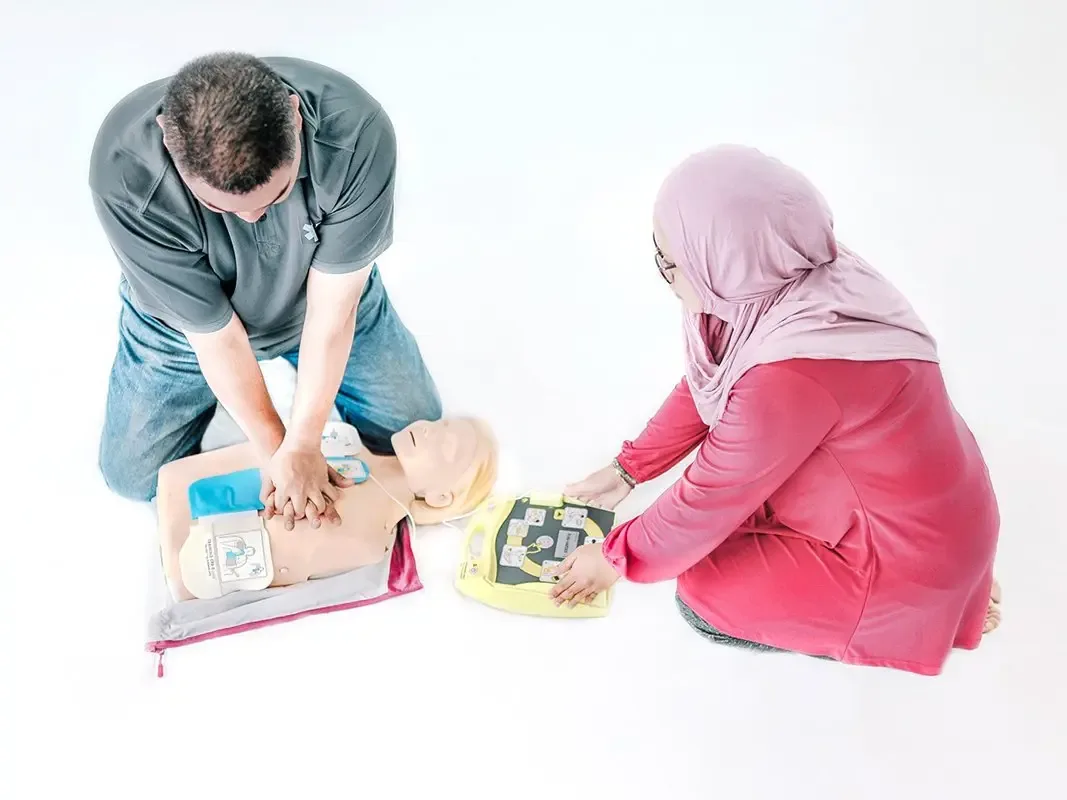
- Adult cardiopulmonary resuscitation.
- Adult relief of foreign body airway obstruction.
- Child cardiopulmonary resuscitation.
- Child relief of foreign body airway obstruction.
- Infant cardiopulmonary resuscitation.
- Infant relief of foreign body airway obstruction.
- Application of an automated external defibrillator (AED).
Entry requirements and health notes. Trainees need enough English to follow the course, and must be physically fit: part of the assessment calls for two minutes of continuous chest compressions and ventilations. Anyone with back, knee, spinal, joint, heart or lung conditions should consult a doctor first, and trainees who are or may be pregnant are advised to enrol after maternity leave.
| Component | Requirement |
|---|---|
| Theory paper | 30 multiple-choice questions, three attempts allowed |
| — Basic Cardiac Life Support | 20 questions, 70% to pass |
| — CPR (Hands-Only) + AED | 10 questions, 80% to pass |
| Practical station 1 | Adult CPR (Hands-Only) + AED |
| Practical station 2 | Infant CPR (Hands-Only) + AED |
| Practical station 3 | Adult foreign body airway obstruction (choking) |
| Practical station 4 | Infant foreign body airway obstruction (choking) |
| Attendance | 100% required to be eligible for assessment |
Source: Medlink Healthcare Group, Basic Cardiac Life Support course page, read 23 September 2026.
Certification
What the course awards on successful completion.
1
Basic Cardiac Life Support (BCLS) + AED Provider Certificate
Accredited by SRFAC and valid for two years, issued in credit-card format on successful completion.
Opting out of the CPR + AED assessment means a Certificate of Attendance only — not the Provider certificate, and not the prerequisite an advanced course will ask for.
Key takeaway: The four practical stations are what make BCLS+AED wider than a hands-only course — two of them are infant stations that no other basic course assesses.
Accreditation
12
How to arrange BCLS+AED training with Medlink
Quick Answer: Booking runs in four steps: confirm which course the requirement names, check whether you are renewing or starting fresh, pick a date before your deadline, then register learners’ details for the certificate.
Most booking problems trace back to step one or two, so work through them in order:
- Confirm the course name. If it says BCLS or BCLS+AED, this is the course. If it says Standard First Aid, book that instead.
- Check your existing certificate date. Still inside the window, including the three months after expiry? Book the refresher. Past it? Book the full course.
- Pick a date with margin. Certificates are issued within 30 days, so leave room before someone needs to see it.
- Register full names as they appear on NRIC or passport. SRFAC requires the learner’s full official name on the certificate, and corrections after issue cost time.
Medlink is a Singapore healthcare group whose work spans first aid training, industrial paramedicine and ambulance services. On corporate bookings, the team will flag where a mixed group is better split across BCLS+AED and first aid courses.
Key takeaway: Confirm the course name, check the certificate date, then book with margin. Those three checks prevent most booking problems.
13
Conclusion: book the date, then diarise the expiry
Quick Answer: BCLS+AED gives you two years of certified competence in adult and infant resuscitation, choking relief and defibrillation, plus eligibility for every SRFAC advanced course. Both expire on the same day.
The basic cardiac life support course Singapore recognises is a short commitment followed by a two-year one. The course is finite; the renewal cycle is not. People who treat the expiry date as a diary entry rather than a surprise almost never re-sit the full course.
If your certificate is still current, the BCLS+AED refresher is the shorter path. If it lapsed past the three-month grace period, start here.
14
Frequently asked questions
Two years from the date of course completion, per SRFAC’s requirements for Training Centres. Re-certification stays available up to three months after the stated expiry date; beyond that, you restart with the full course.
SRFAC sets it at 80 per cent on a paper of at least 20 questions, with up to three attempts. The practical assessment also allows up to three attempts.
BCLS+AED adds rescue ventilations, infant CPR and choking relief for adults and infants. CPR(Hands-Only)+AED assesses compression-only adult CPR and AED use, on a shorter paper of at least 10 questions.
Only partly. SRFAC allows the theory lesson to be completed online on e-learning packages, but the hands-on practice and both assessments must take place in the instructor’s presence.
Yes. Since 1 May 2023, SRFAC has required a valid BCLS+AED Provider certificate to enrol in advanced provider and instructor courses, and to renew advanced-course faculty status.
Not on its own. The Workplace Safety and Health (First-Aid) Regulations require trained first aiders in a ratio to persons employed, and a first aid certificate meets that obligation rather than a resuscitation-only one.
Ready to book your BCLS+AED course?
Tell us whether you are certifying for the first time, renewing before an expiry date, or training a team. We will confirm the right course, the available dates and a GST-inclusive quote.
More From Medlink
Popular first aid courses
Explore other SRFAC and SWDA-accredited courses run by our team, from infant care to workplace certification.
Standard First Aid
+ AED
$196.20 incl. GST ($180 before GST)
See Details
Basic First Aid
+ AED
$141.70 incl. GST ($130 before GST)
See Details
Occupational First Aid
+ AED
$346.62 incl. GST ($318 before GST)
See Details